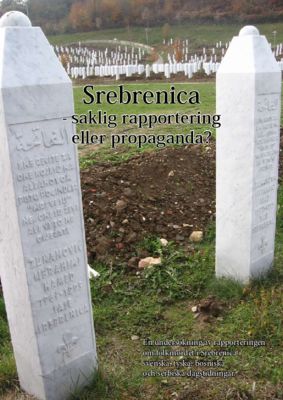
The Bosnian war (1992-1995) was an exceptionally gruesome conflict for journalists. The conditions under which war reporters and war correspondents worked must have made a certain influence on the information they later presented to the public. In order to acquire a better understanding of this problem we chose to concentrate on the Srebrenica genocide. In July 1995 the Bosnian Serbian army, originally a fraction of the army of Yugoslavia, marched into Srebrenica, a small town in eastern Bosnia. The town was occupied by them two years earlier and had since then been a UN safety zone. In spite of that, the Bosnian Serbian army and paramilitaries committed the act of genocide: they separated the men from the women and children and killed them in secret. The women, children and the elderly have been transported out of what then became the Serbian territory.
Kategoriarkiv: Journalistikgranskning
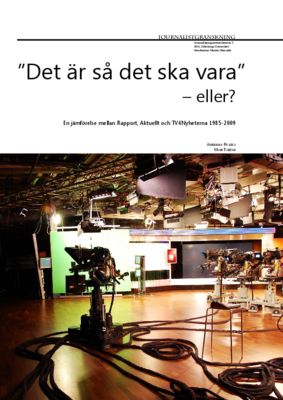
”Det är så det ska vara” – eller?
”That’s how it should be” – or is it?) The Swedish society place a great deal of faith in television news. Important for the viewers then, is to know if they are taking part of journalism that is faceted and that shows different perspectives. So we asked ourselves; is the range of news more narrow today?
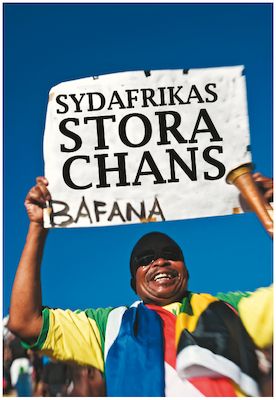
SYDAFRIKAS STORA CHANS
Purpose: To study how the South African government through a free media-service tries to influence what foreign journalists write about the country next year during the first Soccer World Cup ever on African soil. Our purpose is also to find out the views of Swedish correspondents based in Johannesburg on how the World Cup next year can effect the reporting from South Africa.
TERRORSVENSKARNA
Our aim was to find out how seven daily newspapers in Sweden portrayed the three Swedish citizens Mehdi Ghezali, Safia Benaouda and Munir Awad who were arrested in Pakistan in the autumn of 2009, suspected of terrorist activities. We included two morning papers; Dagens Nyheter and Svenska Dagbladet, two evening papers; Göteborgs-Posten and Sydsvenskan. We thought it might differ in some ways from the other papers because Örebro is the hometown of Mehdi Ghezali. Maybe they would take Ghezali in defence more than the other papers?
Männens lekplats
Männens lekplats – the image of women in Swedish popular music-press This paper has it´s aim set to examine the woman´s role in Swedish popular music-press. How big part of the magazines are they allowed to occupy? What sex does the journalist have? And in what way are men and women portrayed? And what has happened in the last 30 years? Is this a man´s, man´s, man´s world as Henrique Norman and Fredrik Svensson called their paper on how women are portrayed in this kind of magazine.
JUDITH
JUDITH – a feministic media critic magazine The aim of this study is to investigate how the family has been portrayed since the end of the 1960’s until today in the Swedish parenting magazine Vi Föräldrar. Our questions are: 1. How is the family and the role of parents portrayed in Vi Föräldrar throughout the years of publication (1968-2009?) 2. Whar causes this portrayal? 3. What are the consequences of this portrayal? Method We have used a qualitative text analysis to analyse 69 articles in nine issues of Vi Föräldrar between 1968 and 2009. We have also interviewed two chief editors (former and current) of Vi Föräldrar, readers of the magazine as well as researchers in various relevant fields e.g. gender and media studies.
EN AIRE
There is a media war going on. And it´s us against them. Partiality and politics in the Venezuelan broad cast media. In Venezuela, recent reports show that the media development in Venezuela is heading in a very scary direction. Reporters without Borders put the country as number 124 in their press freedom index, dropping eleven positions since last year. Global Media Monitoring (GMM) started in 2004 a review of the Venezuelan media´s impartiality in news concerning the referendums. The results showed that the Venezuelan media is extremely polarized. …
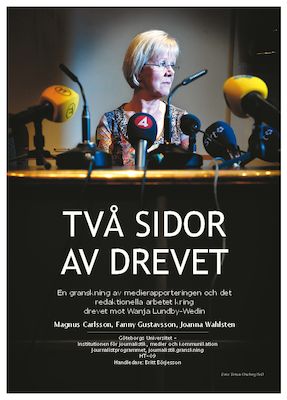
TVÅ SIDOR AV DREVET
Two sides of the witch-hunt journalism Purpose: To get a picture of the media hypo of the AMF-scandal and the media witch hunt of Wanja Lundby-Wedin in Spring 2009. Foremost we wanted to examine how the journalistic work is affected and changed during a media witch hunt or political scandal. We also wanted to examine what journalists think about their articles and about being part of a media hunt. Likewise we wanted to examine whether or not there is a difference in the coverage between newspapers and tabloids.
VAR ÄR VÄRLDEN?
In our work about the foreign news, we took a closer look at the people responsible for producing foreign news, and what they had to say about the current state of the foreign news. Our investigation started in the present and gazed towards the future of foreign press. Who will be responsible for foreign news being reported in the future? In the future development of the foreign news, in what direction will it head? What will the reason be behind the future development of foreign news?
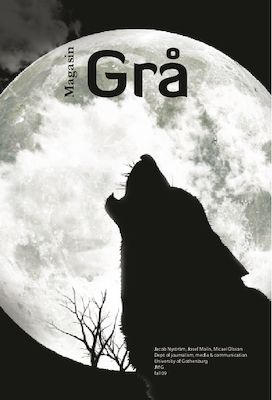
GRÅ Magasin
Our purpose with this paper was to examine how popular culture myths and prejudices influence the journalistic material. To do this we applied a question that has been the subject of a big debate, the wolf issue. We also wanted to examine how different newspapers report on this specific issue. At last, we wanted to examine if newspapers reproduce myths, prejudices and stories instead of reporting news in a nuanced and truthful way.