Kategoriarkiv: Journalistikgranskning

RADIOSKUGGA

The purpose of Radioskugga is to study the working conditions for temporary working journalists. We also investigate how the identity of journalists is affected by job insecurity. To find out how the working conditions of temporary employed journalists look we have carried out 17 qualitative interviews with persons with experience of employment at Sveriges Radio.

DEMOCRAZY

The question about how to handle issues of integration is discussed widely throughout Europe. In general debates concerning immigration and integration policies, Sweden tends to compare itself with Denmark. The common impression is that Denmark has a far too rigid take on integration issues and that they are hostile towards foreigners. The Danes, however, accuse the Swedes of being afraid of addressing the problems and keeping quiet due to political correctness. We found that these ideas are widespread, but few studies actually look at how issues of integration are taken on in the two countries, especially in media research.

BROTT AV SIN TID

The purpose of the project is to investigate possible changes in the Swedish evening press and their way of reporting. In this case we have chosen the two biggest evening newspapers Aftonbladet och Expressen. To do so we choose to look at two of Sweden´s most media covered events in later years, the infamous ”Lasermannen”. Lasermannen or John Ausonius acted during the years 1991-92 in Stockholm. He became an almost mythical person that injured ten people and killed one person before the police arrested him. The other case is similar in many ways to that of Lasermannen but took place in Malmö. In 2010 a single offender, in media called ”Malmöskytten”, shoots a number of people based on their ethnical origin.

thumbnail of kv11-11_0-3

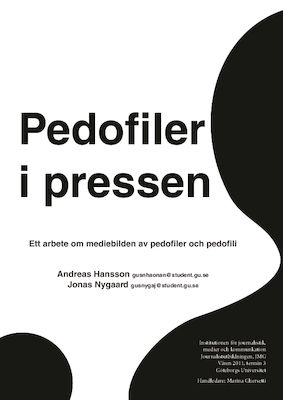
Pedofiler i pressen

This study strives to describe and analyze how Swedish press portraits pedophiles and child molesters and what possible effect this image could have. It also seeks to show how this image compares to ”reality”. We have analyzed the four major newspapers in Sweden during the year 2010 and interviewed experts, journalists, victims, pedophiles and a news editor.

thumbnail of kv10-14-3

SUBKULT

Purpose: The aim of our work is to find out how the subcultures are being portrayed in Swedish newspapers. We wondered if the picture that emerges of subcultures is positive or negative. If cultural practitioners feel their culture is portrayed fairly and how they feel it is interpreted. Thesis: We had at the start of our work, a thesis that the representation of subcultures in the Swedish daily press is not a particularly positive reception of the practitioners themselves, that picture that emerges without some basis in reality and based on standard images.

QWX

QWX: The purpose of this paper is to analyse how Kurdish and Turkish journalists and media representatives perceive the media climate in Turkey and how it has developed over the last ten years, focusing on the situation for Kurdish media and journalists. The paper includes theory of media and democracy, focusing on the role of freedom of expression and press freedom in a democracy. Other theories of importance for this paper are framing and media and identity. 25 qualitative semi-structured in-depth interviews with journalists and media representatives have been carried out between March 10th and April 6th 2010. Complementary interviews have been carried out with other media representatives, human rights activists and researchers.

thumbnail of kv10-17-3

HELLO AFRICA!

Purpose and questions We wanted in our paper to explore how Swedish press covers Africa and to find out the possible reasons why the coverage looks in a specific way and also to find out how people in Africa are being portrayed and the possible consequences of the Swedish media´s description of Africa. Research We have used the central research about attribute agenda setting to look at the consequences of the news being the way they are, and the theories of news evaluation of Galtung and Ruge when looking at what makes the news. We also work with the principle of different gatekeepers which is people in position to decide what makes news.

Aftonbladet och Expressen – En besvärlig situation?

Purpose: To find out whether the music journalism in the two largest tabloids in Sweden, Aftonbladet and Expressen has been commercialized between the years 2000-2009, and if so, how it has been reflected in the music-related editorial material in these two tabloids. We also want to investigate how the conditions to produce music journalism have been during this period and what kind of role the individual music journalists have had. Thesis: We believe that the commercialization has increased and that it has had a direct effect on the editorial material within the music pages of Aftonbladet and Expressen, and also that the most obvious sign of this progress is that journalism itself has taken a more sensational turn. Method: Qualitative content analysis of 40 articles and interviews with one scholar and several music journalists. Main results: The commercialization in both Aftonbladet and Expressen is noticeable. But it is more obvious in the case of Aftonbladet where the editorial material has a higher level of sensational headlines and angles and a more populist underline than Expressen. There is also an outspoken attitude from the music editors that the harsch economic reality of the tabloid industry needs them to meet and satisfy the public demands.