Kategoriarkiv: Journalistikgranskning

thumbnail of kh10-2-3

UTANFÖR

The purpose of Utanför – bilden av romer i svensk press is to study the image of Romani people in Swedish printed media, and to study the reasoning amongst the editorial staff when reporting about minorities. We also examine how their portrayal in the media affects Romani people´s self-image and their trust in media. Through qualitative analyzing of the material in Swedish newspapers and interviews with Romani people, we are trying to answer these questions. To determine how Romani people are presented in printed media we have performed four studies of newspaper material: how Romani people are presented during two weeks of October, 2010, how Romani people are presented during the four months of the year 2000, how newly arrived Romani people in Ryd and on Öland are presented in 2002 and 2010, and a study of the newspaper material covering the conflict amongst neighbours in Vojakkala, 1999, 2008 and 2009. In his bachelor thesis, Mediemytiska romer (2002), Tobias Nilsson conducted a study of how Romani people are viewed in the media. He requested a study of how Romani people perceive the way they are viewed and how it affects them, something this study is meant to answer. Ylva Brune´s research about how inferior groups are being presented in Swedish media has also been a great help during the process of this study.

thumbnail of kv10-5-4

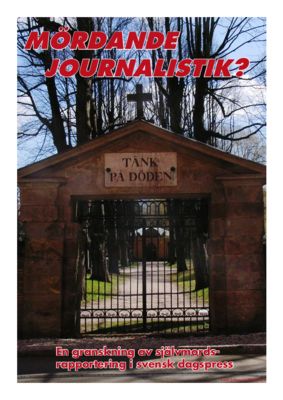
Mördande journalistik?

Suicide is a controversial subject when it comes to media reporting in Sweden. Often journalists tend to avoid the subject out of fear of spawning more suicides among its audience. The notion that giving attention to suicides in media will spawn even more suicides is called the werther effect. Recently we have seen a change in trend in Swedish media when it comes to suicide. The last ten years the media has started to give more attention to suicide cases than before. Often the reports are focused on celebrity suicides, but even specific suicides committed by commoners have seen its share of attention. In this work, the authors are investigating this new trend in Swedish media reporting. More specifically this study is committed to investigating how journalists report when it comes to suicide. In parallel to this, the study also tries to investigate whether there is any substance in fearing the werther effect.

SMEDJA i MEDIA

Think Tanks in the Daily Press is an overview of the Swedish market of think tanks (or ”tankesmedjor”, ”thought forges”), primarily advocacy think tanks with an ideological mission, and how they use the daily press to influence the political climate. The study is comprised of a qualitative content analysis of three of Sweden´s biggest and most influential daily papers: Svenska Dagbladet, Dagens Nyheter and Aftonbladet, over a time span of 10 years, 10 months and 10 days (2001-01-01 – 2010-10-10). The analysis focuses on ”viewpoint space” and the presence of ”competitive viewpoints” in a total of 928 articles where think tanks can be said to express a viewpoint based on the ideological or political views around which the think tank operates. The quantitative study is accompanied by a series of interviews: CEO:s at some of the leading Swedish think tanks, the editors of op-ed pages in the newspapers of the content analysis, the news editors, and scientists in the fields of Media and Political Science all give their view on how the think tanks operate in the daily press: How it has changed since the year 2000 and how the think tanks are likely to operate in the 10 years to come. The study also includes a historical overview of think tanks and the Swedish related term ”tankesmedja”, as well as problematization of the use of the Swedish word in relation to its American origin. Purpose: To get an overview of which attitudes towards Swedish advocacy think tanks that are present in editorial offices, and on the other hand, how the think tanks work in correlation with these offices.

thumbnail of kv10-6-4

Kina – ett svårlagt pussel

The aim of this paper is to find out how the six largest Swedish newspapers depict China. It also looks at how Swedish journalists and newspaper editors define their democratic responsibilities as journalists, and whether they fulfill the ideals and responsibilities that are part of the idea of journalism as an important part of democracy, for example scrutinizing of those in power and explanation of complicated events to the public. The paper aims to answer three questions: What are the responsibilities of the Swedish media when reporting from China? What is the image of China in Swedish newspapers? Do the Swedish journalists fulfill their democratic responsibilities when reporting from China?

thumbnail of kv11-4_0-3

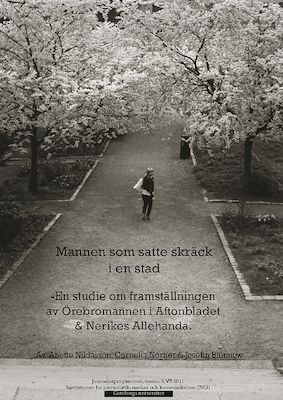
Mannen som satte skräck i en stad

Purpose: In this study we aim to study how two newspapers – Nerikes Allehanda and Aftonbladet, have chosen to portrait Sweden´s worst serial rapist, Niklas Eliasson. We are interested in conceiving explanations as to why the reporting comes across the way it does. What consequences could it have? To be able to answer this, we intend to proceed from a series of fundamental questions: – What deliberations were taken into consideration, while writing the articles? – How do the journalists regard their articles and the portrayal of Niklas Eliasson? – Why was he portrayed the way he was? – How do the experts and police look upon the portrayal? – How is Niklas Eliasson portrayed in the media (in this case Aftonbladet and Nerikes Allehanda?) – Does the media´s portrayal have any stereotyping effects of the perpetrator?

thumbnail of kv10-7-4

GAME OVER

Aim Our aim is to shed light on a relatively new field of journalism: e-sports and see how it is being treated by three Swedish newspapers. Main questions What attributes gets pinned on to e-sports and how is people involved with e-sports described in articles? What are three of the biggest Swedish newspapers reporting about e-sports and gaming culture? How is their content different to online e-sportsites? How is the e-sportplayer pictured in traditional press?

thumbnail of kv10-8-4

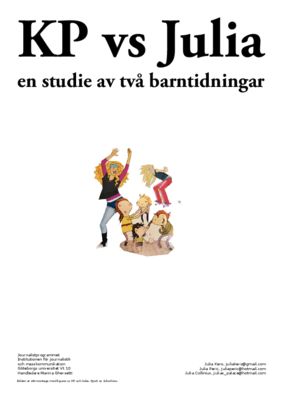
KP vs Julia

Purpose Media is one of the four agents of socialization. The other agents of socialization are family, friends and school. The identity of children is influenced by the articles in magazines. The power of the media declines in adult years but still remains strong. This theory was the starting point of our article.

thumbnail of kv10-9-4

NANCY SOM I NANCYMORDET

Purpose: To describe the news coverage of the murder of Nancy Tavsan in 2010 and the murder of Malin Olsson in 1994, in Göteborgs-Posten and Göteborgs-Tidningen. To compare the coverage within each paper and between the two papers. Problem statements: – What is distinctive for the coverage of the two murders, in each paper? – How does the coverage differ over time and between the two papers? – What are the causes for the differences?

thumbnail of kv10-10-4

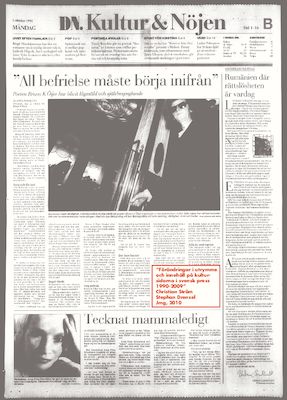
Förändringar i utrymme och innehåll på kultursidorna i svensk press 1990-2009

The purpose of the project is to study whether, and how, the increase of articles concerning entertainment and popular culture has decreased the number of articles concerning more classical culture journalism. The hypothesis is that the increase is an effect of the papers trying to broadening its audience by giving it a more easily accessible material which, in the light of news value theories, could be a sign of commercialization. Narrowed down to simple questions the articles try to investigate: How many articles in the newspapers is concerning culture today compared to 20 years ago? What is the relation between articles concerning entertainment and articles about culture? Are there changes in the way culture is presented today compared to 20 years ago? If any, what is the reason for these changes (in content/or in number of articles and space given?) And: How do these changes fit in with the theories of commercialization?

ID: tjej

”ID:girl” A look at the effects that teen magazines may (or may not) have upon young girls creation of their selves. Why? Our purpose with this project was to investigate the contents of three Swedish popular magazines (FRIDA, OKEJ & VeckoRevyn) for young girls (7th – 9th grade) We wanted to know: the content and what values it distributes? how, if at all, it has changed from 1990 until 2010? what effect does the content have upon young girls creation of their identities? what do the readers think of the magazines?