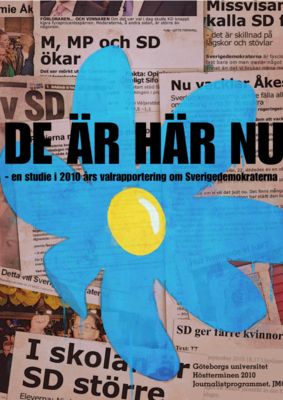
This study aims to examine how the press reported on the Sweden Democrats during the three days before and three days after the Swedish Election Day in September the 19th 2010 and which strategies the press used. The analysis is based on six large Swedish newspapers: Dagens Nyheter, Svenska Dagbladet, Expressen, Aftonbladet, Sydsvenskan and Göteborgs-Posten. Did the Swedish press use ordinary journalistic procedures when they reported about the Sweden Democrats?
Författararkiv: linneus
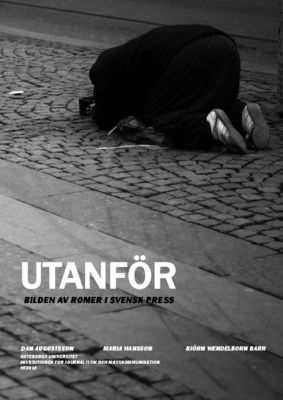
UTANFÖR
The purpose of Utanför – bilden av romer i svensk press is to study the image of Romani people in Swedish printed media, and to study the reasoning amongst the editorial staff when reporting about minorities. We also examine how their portrayal in the media affects Romani people´s self-image and their trust in media. Through qualitative analyzing of the material in Swedish newspapers and interviews with Romani people, we are trying to answer these questions. To determine how Romani people are presented in printed media we have performed four studies of newspaper material: how Romani people are presented during two weeks of October, 2010, how Romani people are presented during the four months of the year 2000, how newly arrived Romani people in Ryd and on Öland are presented in 2002 and 2010, and a study of the newspaper material covering the conflict amongst neighbours in Vojakkala, 1999, 2008 and 2009. In his bachelor thesis, Mediemytiska romer (2002), Tobias Nilsson conducted a study of how Romani people are viewed in the media. He requested a study of how Romani people perceive the way they are viewed and how it affects them, something this study is meant to answer. Ylva Brune´s research about how inferior groups are being presented in Swedish media has also been a great help during the process of this study.
SMEDJA i MEDIA
Think Tanks in the Daily Press is an overview of the Swedish market of think tanks (or ”tankesmedjor”, ”thought forges”), primarily advocacy think tanks with an ideological mission, and how they use the daily press to influence the political climate. The study is comprised of a qualitative content analysis of three of Sweden´s biggest and most influential daily papers: Svenska Dagbladet, Dagens Nyheter and Aftonbladet, over a time span of 10 years, 10 months and 10 days (2001-01-01 – 2010-10-10). The analysis focuses on ”viewpoint space” and the presence of ”competitive viewpoints” in a total of 928 articles where think tanks can be said to express a viewpoint based on the ideological or political views around which the think tank operates. The quantitative study is accompanied by a series of interviews: CEO:s at some of the leading Swedish think tanks, the editors of op-ed pages in the newspapers of the content analysis, the news editors, and scientists in the fields of Media and Political Science all give their view on how the think tanks operate in the daily press: How it has changed since the year 2000 and how the think tanks are likely to operate in the 10 years to come. The study also includes a historical overview of think tanks and the Swedish related term ”tankesmedja”, as well as problematization of the use of the Swedish word in relation to its American origin. Purpose: To get an overview of which attitudes towards Swedish advocacy think tanks that are present in editorial offices, and on the other hand, how the think tanks work in correlation with these offices.

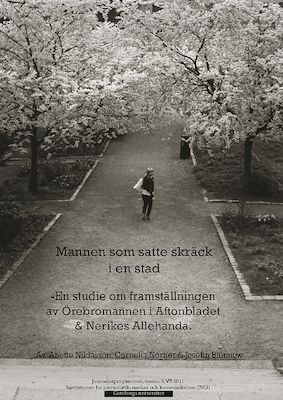
Mannen som satte skräck i en stad
Purpose: In this study we aim to study how two newspapers – Nerikes Allehanda and Aftonbladet, have chosen to portrait Sweden´s worst serial rapist, Niklas Eliasson. We are interested in conceiving explanations as to why the reporting comes across the way it does. What consequences could it have? To be able to answer this, we intend to proceed from a series of fundamental questions: – What deliberations were taken into consideration, while writing the articles? – How do the journalists regard their articles and the portrayal of Niklas Eliasson? – Why was he portrayed the way he was? – How do the experts and police look upon the portrayal? – How is Niklas Eliasson portrayed in the media (in this case Aftonbladet and Nerikes Allehanda?) – Does the media´s portrayal have any stereotyping effects of the perpetrator?
JUDITH
JUDITH – a feministic media critic magazine The aim of this study is to investigate how the family has been portrayed since the end of the 1960’s until today in the Swedish parenting magazine Vi Föräldrar. Our questions are: 1. How is the family and the role of parents portrayed in Vi Föräldrar throughout the years of publication (1968-2009?) 2. Whar causes this portrayal? 3. What are the consequences of this portrayal? Method We have used a qualitative text analysis to analyse 69 articles in nine issues of Vi Föräldrar between 1968 and 2009. We have also interviewed two chief editors (former and current) of Vi Föräldrar, readers of the magazine as well as researchers in various relevant fields e.g. gender and media studies.
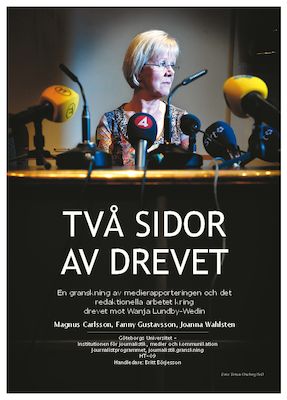
TVÅ SIDOR AV DREVET
Two sides of the witch-hunt journalism Purpose: To get a picture of the media hypo of the AMF-scandal and the media witch hunt of Wanja Lundby-Wedin in Spring 2009. Foremost we wanted to examine how the journalistic work is affected and changed during a media witch hunt or political scandal. We also wanted to examine what journalists think about their articles and about being part of a media hunt. Likewise we wanted to examine whether or not there is a difference in the coverage between newspapers and tabloids.
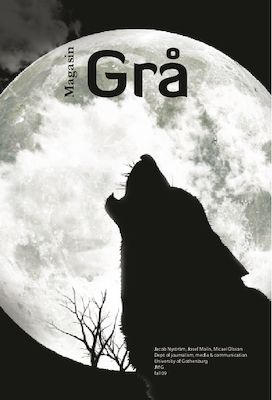
GRÅ Magasin
Our purpose with this paper was to examine how popular culture myths and prejudices influence the journalistic material. To do this we applied a question that has been the subject of a big debate, the wolf issue. We also wanted to examine how different newspapers report on this specific issue. At last, we wanted to examine if newspapers reproduce myths, prejudices and stories instead of reporting news in a nuanced and truthful way.
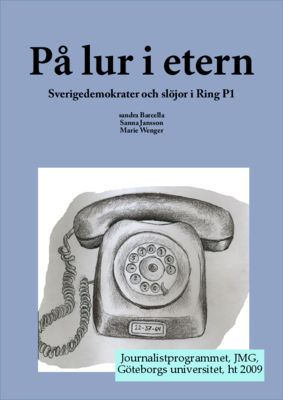
På lur i etern
På lur i etern studies the debate on immigrants and other cultures in the call-in radio programme Ring P1. We investigate and problematize public discourse in a programme where anyone can take part. What characterizes the debate about immigrants and other cultures, and how do the moderators handle it? Our questions thus work on two levels: The debate: How much time does talk about immigrants and other cultures take up in the program? What subjects are brought up by the callers and how do they argue around them? The dynamics of conversation: How do the moderators act in conversations? What are the consequences of different moderators´strategies? Are there limits for what can be said and, in that case, what do these limits look like?
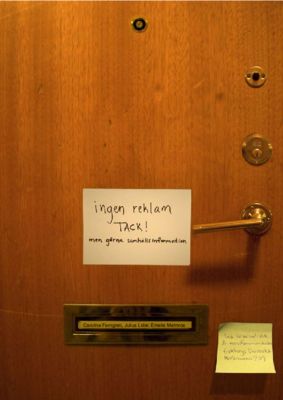
Ingen reklam tack! … men gärna samhällsinformation
This paper seeks to find out more about editorial advertising and the attitudes concerning it in Sweden today. What is editorial advertising, and to what extent does it exist in Swedish daily press? What do journalists and editors think about these subjects, and have their thoughts changed since the Committee against editorial advertising disappeared in 2005? Our study of five newspapers: Dagens Nyheter, Aftonbladet, Metro, Helsingborgs Dagblad and Hallands Nyheter during 2009 shows, for example, that half of the texts in these newspapers contain a company name or a product, and that this is most frequent in consumers journalism. It is nearly impossible to define exactly what editorial advertising is. Hence it is also difficult to say how we can prevent it from destroying the credibility of Swedish daily press.
3500 röster på nätet
To find out how reader comments on news articles about immigrants, multi-culture and immigration differ from each other on Sweden´s six biggest newspaper webbsites. And further, if there is a difference, try to understand why this is the case. We also wanted to survey if there were any xenophobic tendencies among the commenters. The hypothesis was that by choosing the multi-culti subject on the articles, we would get a lot of racist comments, which are interesting because of the recent success of Sverigedemokraterna, a Swedish xenophobic nationalistic party.