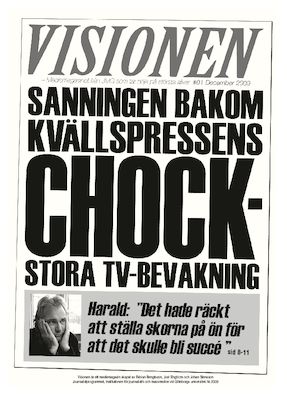
Sammanfattning: Kvällspressen insåg tidigt att TV inte bara innebar ny konkurrens utan kanske snarare ett nytt bevakningsområde som samlar läsarna. Då vi nu rör oss mot ett allt mer differentierat TV-tittande förändras så klart pressens roll.
Författararkiv: linneus
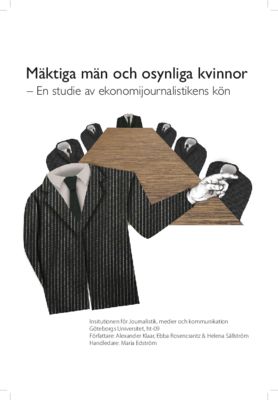
Mäktiga män och osynliga kvinnor
The occurrence of male and female principal characters in Swedish and Norwegian economic press was studied. In total 1318 articles from the years 2002 and 2009 were studied through quantitative analysis. The aim was to study whether an increase of the female representation in the economic press can be said to have taken place. Norway has since 2008 adopted a law that obliges all Norwegian public companies registered on the Norwegian stock market to have a female representation of at least 40 percent in their boards. An investigation of its effect on the female representation in the economy press is therefore of interest. The main finding was that women occur as principal characters more frequently in Norwegian and Swedish economy press in 2009 than in 2002. The comparative increase of female principal characters was found to have been more pronounced in the Swedish daily press than the Norwegian.
Ekonomijournalistens dilemma.
Ekonomijournalistens dilemma, The Dilemma of the Economic Journalist, is a magazine about Swedish economic journalism. The question we set out to answer is if Swedish economic journalism can be considered investigative. This question is based upon the notion that corporations and the business sector possess a considerable amount of power, over society and the lives of the ”ordinary people”. This power needs to be scrutinized by the mass media and we wanted to know if any scrutinizing is taking place.
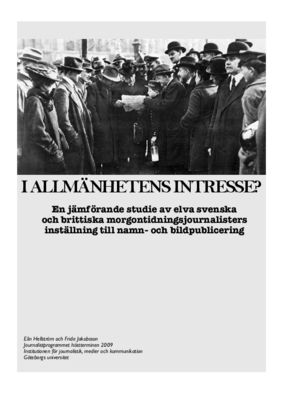
I ALLMÄNHETENS INTRESSE?
In the public interest? A comparative study of eleven Swedish and British newspaper journalists´attitudes regarding publication of names and photographs.
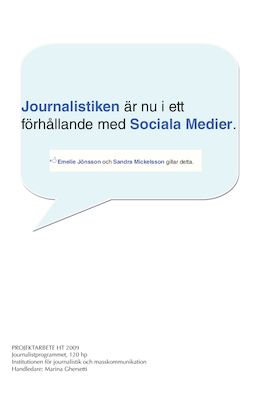
Journalistiken är nu i ett förhållande med Sociala Medier
Journalism is now in a relationship with: Social Media To compare how Svenska Dagbladet in Stockholm, Sweden and StarLedger in New Jersey, USA use social media in their journalistic work. We also want to see how social media affects journalism. We used participation studies and interviews. When studying new phenomena, such as the development of social media, participation studies is a preferable method. Interviews further deepend our insight in the subject.
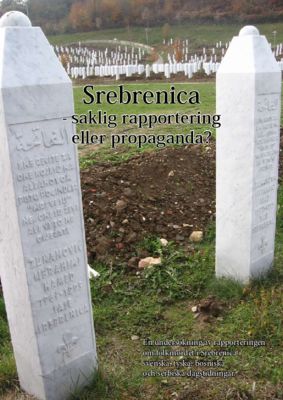
Srebrenica
The Bosnian war (1992-1995) was an exceptionally gruesome conflict for journalists. The conditions under which war reporters and war correspondents worked must have made a certain influence on the information they later presented to the public. In order to acquire a better understanding of this problem we chose to concentrate on the Srebrenica genocide. In July 1995 the Bosnian Serbian army, originally a fraction of the army of Yugoslavia, marched into Srebrenica, a small town in eastern Bosnia. The town was occupied by them two years earlier and had since then been a UN safety zone. In spite of that, the Bosnian Serbian army and paramilitaries committed the act of genocide: they separated the men from the women and children and killed them in secret. The women, children and the elderly have been transported out of what then became the Serbian territory.

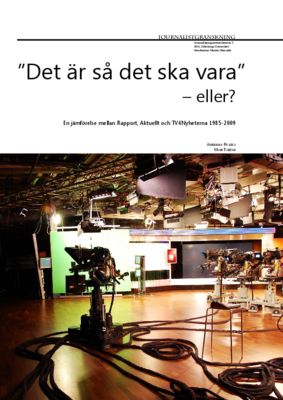
”Det är så det ska vara” – eller?
”That’s how it should be” – or is it?) The Swedish society place a great deal of faith in television news. Important for the viewers then, is to know if they are taking part of journalism that is faceted and that shows different perspectives. So we asked ourselves; is the range of news more narrow today?
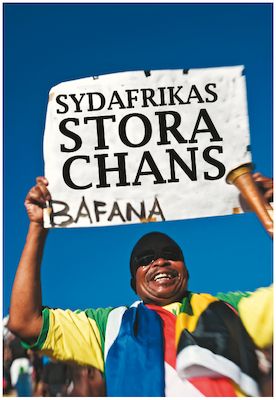
SYDAFRIKAS STORA CHANS
Purpose: To study how the South African government through a free media-service tries to influence what foreign journalists write about the country next year during the first Soccer World Cup ever on African soil. Our purpose is also to find out the views of Swedish correspondents based in Johannesburg on how the World Cup next year can effect the reporting from South Africa.
TERRORSVENSKARNA
Our aim was to find out how seven daily newspapers in Sweden portrayed the three Swedish citizens Mehdi Ghezali, Safia Benaouda and Munir Awad who were arrested in Pakistan in the autumn of 2009, suspected of terrorist activities. We included two morning papers; Dagens Nyheter and Svenska Dagbladet, two evening papers; Göteborgs-Posten and Sydsvenskan. We thought it might differ in some ways from the other papers because Örebro is the hometown of Mehdi Ghezali. Maybe they would take Ghezali in defence more than the other papers?
Männens lekplats
Männens lekplats – the image of women in Swedish popular music-press This paper has it´s aim set to examine the woman´s role in Swedish popular music-press. How big part of the magazines are they allowed to occupy? What sex does the journalist have? And in what way are men and women portrayed? And what has happened in the last 30 years? Is this a man´s, man´s, man´s world as Henrique Norman and Fredrik Svensson called their paper on how women are portrayed in this kind of magazine.