Kategoriarkiv: Journalistikgranskning

Bilder av män(niskor)

This bachelor thesis examines photojournalistic images in contemporary Swedish press from a gender perspective. Gender inequality is reproduced through news content every day. Behind all photojournalistic images is the photographer, a person who makes decisions regarding the angle of the picture, its composition, environment and light. In addition, the photographer is often able to influence the body language, posture and facial expression of the person portrayed. Through these daily choices of the photojournalist, the media have the power to strengthen or challenge the gender hierarchy by selecting and publishing certain images (Jarlbro 2013:65). Previous studies on media content show that gender stereotypes of women and men are so common that they often go unnoticed (Fagerström & Nilson 2008:125-127). Taken that media shall function as an interactive venue where all individuals are seen on equal terms, stereotypical representations of men and women in the news should be considered a democratic problem (Jarlbro 2013:19, 92). By applying a qualitative content analysis, our aim is to investigate how photojournalistic images can strengthen or infract typical gender patterns, where men and women are represented differently due to inequal norms and values in society. This study includes six different photographs from the Swedish local morning paper Göteborgs-Posten. The photographs were analyzed by examining aspects such as body language, facial expressions, picture angle and context. The main findings of this study show that both women and men in the analyzed photographs are represented in stereotypical ways in terms of gender. In most cases, men are portrayed as active, powerful and independent in a way that enhance their masculinities, whereas women act passively in a way that confines and victimizes them. Two of the photographs partly challenge this gender order by portraying men in situations where they appear weak or exposed. Representations of women on the other hand do not conflict with the gender order. Still, none of the photographs challenge the hegemonic masculinity (Connell 1995:76-80). Through our results we also want to highlight how the consequences of stereotypical gender representations obstructs the development of gender equality in news content and in society. By applying Entman’s theories (1993:51-52) to our analysis it is possible to conclude that the framing of media content inevitably influence our ideas and expectations of men and women in society. In conclusion, stereotypical representations of men and women in turn contributes to the strengthening of gender stereotypes in media content as well as in society.

thumbnail of kh15-10-4

STRÖMMAR FRÅN MEDELHAVET

On September 2 2015 a three-year-old Syrian boy named Alan Kurdi was found dead on the beach in Bodrum, Turkey. Alan Kurdi is one of thousands refugees who have drowned while taking the dangerous boat ride over the Mediterranean Sea to escape terror and war in Syria. The shocking picture of his body became the starting point of massive media coverage of the refugee situation in Europe today. According to UNHCR, over 50 million people in the world are refugees today and about 900.000 of them have arrived in Europe by the Mediterranean Sea in 2015. In this Bachelor thesis we are examining the Swedish media portrayal of the refugee situation in Europe. By using a quantitative method and applying theories of newsworthiness and social identity, we have studied 490 articles from September 2015 in Sweden’s four largest newspapers: Dagens Nyheter, Svenska Dagbladet, Aftonbladet and Expressen. Our aim is to find out how the refugee is portrayed by looking at each person’s gender, age, name, title and position in the article. We want to find out if there is any stereotypical way of presenting the refugees. Furthermore, we want to know if the refugees get to define their own situation or if there are other actors such as politicians, organizations or journalists speaking above their head. Our results show that the newspapers are providing a rather chaotic picture of the refugee situation. Words such as catastrophe, crisis and stream are frequently used to reinforce the impression of turmoil. Forceful words like these can create negative associations amongst the readers and has the potential to influence their opinion about refugees. Refugees get to speak in approximately 60 percent of the articles, but they are rarely the most cited actor. Politicians and columnist are often speaking above their heads. Moreover, we have found a significant difference in the portrayal of men and women. Men are overrepresented in all of the categories in our study. This can partly be explained by the fact that there are more men than women amongst the refugees (according to UNHCR). Nevertheless, the female refugees that do occur in the articles are less likely to be presented with a professional title and less often occurs as the main actor.

thumbnail of kh15-11-4

Dömd på förhand?

The purpose of this study is to analyze how the Swedish media publishes personal records in their coverage of three infamous murder cases in Sweden in 2015: the murder of Lisa Holm, the murders at Ikea in Västerås and the school attack in Trollhättan. The study also seeks to compare differences between alternative right wing media’s and mainstream media’s coverage of the cases. The results of the study will be compared to the Swedish rules of press ethics. The method in use will be content analysis, and the material will consist of articles in the Swedish daily newspapers Aftonbladet and Expressen, together with the right wing alternative news sites Avpixlat and Fria Tider. Articles that are published within the first month of the events. The main results showed that there are big differences between how the alternative and the mainstream media publishes personal records. The alternative media has for example published the name of the suspects in all three cases. They also have a bigger focus on ethnicity when writing about both suspects and victims. The alternative media have also broken more of the Swedish rules of press ethics, although the traditional media also has broken quite a few.

thumbnail of kh15-12-4

Att tyda sin omvärld

The purpose of this study is to investigate whether Swedish foreign aid and diplomatic policies has any effect on the selection of foreign news in Swedish news media. We set out to study news concerning countries that experienced a change in their relation to the former Swedish government, which was in rule between 2006 and 2014. The countries we chose for this was Nicaragua, Laos and Senegal, where the Swedish embassies were closed in this period. For Nicaragua and Laos the aid was also reduced. Further, Bolivia, Cambodia and Mali were chosen since the Swedish government opened embassies there, as well as strengthening existing aid programs. Our theoretical points of departure have mainly been a set of different studies on news values; the science of what events becomes news. We have included both the broader theories concerning foreign journalism in general and more specifically those concerning the relationship between foreign journalism and foreign policies. We had two research questions: Has there been any change in the amount of news material from reaching us from these countries since the changes in Swedish representation took place? Has there been any change in the kind of information that reaches us from these countries? Our study was conducted as a quantitative content analysis in which we have studied the amount and nature of news material from our countries of choice in Swedish news media, before and after the changes in Swedish relations towards these countries took place. The results of the study shows that changes in Swedish relations did not seem to affect the presence of those countries in Swedish news media, nor how they were represented in the major Swedish newspapers. No clear patterns were found except that of the general decrease of news from the countries we chose for our study.Our conclusion was that any further studies on this subject would need to encompass a much greater amount of material and a greater knowledge of the editorial circumstances of each news media-object.

thumbnail of kh15-13-4

Caring is sharing:

The purpose of our study was to research people’s media habits when it comes to news consumption through social media, Facebook in particular, and to try to ascertain if our theory that people today are lacking in source criticism skills has any basis in reality. Our theory is that social media users who rely solely or primarily on Facebook for news consumption are less likely to compare media coverage between outlets and channels, and validate sources, than consumers of traditional media. Broken down into component parts, the main questions we were looking to answer were: • To what extent does our population rely on Facebook as a primary or sole source for news and media coverage? • In what manner does relying primarily or solely on Facebook for news content influence criticism of sources and user acceptance of news content posted directly to their curated feeds? The method we chose was a quantitative study, as we believed that it was more important to begin with finding the frequency of these phenomena before studying the subject on a deeper level. This was done through an online survey that we had intended to send to certain groups of Swedes within the age range of 18-36, but due to being unable to find a way to reach this population we were forced to lessen our scope, and ended up with a highly limited group of respondents that led to a total of only 122 replies. As a result, our conclusions are only relevant for Swedish students of media, journalism and communication sciences. But within that subset, we did not find any conclusive evidence that the theories that we based our study on are grounded in reality. Also, due to the training and expertise of our population, it is not unlikely that they have a more critical approach to news, especially unsourced reports on social media sites. It also seems prudent to assume that they spend more time consuming news than the average person. In conclusion, it would seem that students of these sciences have a very balanced and self-aware approach to source control and criticism in social media environments, applying the same or even stricter guidelines. We also believe that our theoretical framework is sound and that the groundwork that we have done is solid, and as such present this thesis in part as a proof of concept with components that would be suited to be used for larger studies within the field in the future.

”Allt handlar om korruption, brott, demonstrationer och om diktatorn Putin”

Title: ”It’s all about corruption, crimes, demonstrations and the dictator Putin” A quantitative study of Dagens Nyheters coverage of the Soviet union and Russia. Authors: Axel Bjurklint & Simon Löfving Subject: Undergraduate research paper in journalism studies Location: Dept of journalism, media and communication (JMG) University of Gothenburg Number of pages:50 Background: Today there is an ongoing debate between Swedish journalists on how they are portraying Russia. And there are severe differences between their opinions. Soviet and Russia´s actions has always concerned Sweden. And affected Swedish politics. Purpose: The main purpose was to examine how the Swedish newspaper Dagens Nyheter has been portraying Soviet and Russia over time. Further, explaining why the media image has changed or how it has been upheld. Method: A quantitative content analysis of Dagens Nyheter using a digital search string designed to short out all the news concerning Russia in March 2003 & 2013. The articles from 1983 & 1993 were collected from the press archive in the library of Gothenburg university. The total amount of articles: 131. The articles were coded and registrated in the statistic program SPSS with 21 different variables. Results: The media image has been continuously negative from 1983 to 2013. Only eight percent of all the articles in this study have been positive. The results might be explained by Sweden’s interest in portraying Soviet and Russia as their cultural and political antithesis.

Filmrecensioner och personerna bakom dem – journalister eller något annat?

Title: Filmrecensioner och personerna bakom dem – journalister eller något annat? Deras egna röster om yrket, PR & oundviklig reklam inom branschen 2014 Authors: Emelie Andréasson and Gustaf Dominicus Subject: Undergraduate research paper in journalism studies, Dept of journalism, media and communication (JMG), Gothenburg University Term: Fall of 2014 Supervisor: Mathias A. Färdigh, JMG, Gothenburg University Purpose: Our main focuses were the following points – How does a film critic work? How does the film critics view themselves – as journalists or mere writers? Do they work according to the same ethics as other journalists? – What kind of films do they review? What kind of films do they not review? And why? – How do film critics and their editors think regarding the form of the film reviews? Do they spice up their writing in order to get more people to read their film reviews and to get much needed attention online? – Is there an existing cooperation between the film critics/their editors and the PR sector? If there is – how does it work? And, how does it affect the film reviews? Method: Quantative analysis and qualitative analysis Procedure: We have conducted one web survey and eight in-depth interviews with film critics. Results: We found that different film critics work in different ways. Some are employed and work for larger news papers and some work as freelancers. What connects them all is that they get films to review appointed to them, they rarely choose film themselves. Their editor has the final say. Some have backgrounds as journalists and most definitely see themselves as such. Some have degrees in other areas and therefore do not regard themselves a journalists. All agree that they are allowed to speak their mind more freely than other journalists as reviewing films is their job. Even so, all report that they keep rules such as ethics in mind during their line of work. The films they review are mostly the ones that hits the theaters. Some also review new dvd releases.

thumbnail of kh14-20-3

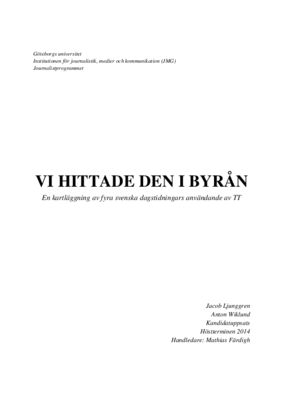
VI HITTADE DEN I BYRÅN

The purpose of the study was firstly to describe the use of news articles from the largest Swedish news agency, TT Nyhetsbyrån, in four Swedish newspapers. Secondly, the purpose was to see if there was a homogenization of which TT-articles that was used. This was carried out by examining articles on the newspapers’ local, domestic and foreign pages. The newspapers that was chosen were Aftonbladet, Dagens Nyheter, Göteborgs-Posten and Nerikes Allehanda. They were chosen due to their size and their coverage area. This was because of a hypothesis that larger newspapers in general have more resources and should therefore not be as dependent on material from news agencies. As for the coverage area, the chosen newspapers were divided into two local and two nationwide, to be easier to compare in those categories. The theoretical premises for the study was first and foremost the normative demands of journalism in a democracy and were based on the theories regarding information value, brought forth by Kent Asp, as well as other theories regarding normative demands. Previous research in the area is somewhat frugal even though there are quite a few previous studies that have examined TT. The study was a quantitative content analysis carried out through a template by own construction. The four chosen newspapers were analyzed between 14-18 October 2013. These dates were determined by a pilot study where Aftonbladet and Dagens Nyheter had been analyzed throughout the year 2013. The conclusion drawn from the pilot study was that the medium number of TT-articles in the newspapers appeared in October, which is why those dates were chosen. The results of the study showed that 41 percent of the analyzed articles were produced by TT, while 56 percent was produced by the newspaper itself. 3 percent of the articles had no byline. However, on the local pages, the amount of articles from TT was only 9 percent, while the amount on the domestic and foreign pages were 53 and 49 percent. When it comes to the homogenization of articles, it was shown that out of 189 separate TTarticles, 4 occurred in three of the newspapers, 43 occurred in two of the newspapers and the remaining 142 TT-articles were found in one of the newspapers. In conclusion, the study showed that by the study itself it is impossible to determine whether or not the normative demands of journalism were upheld by the newspapers use of TT-material. This was to some extent due to the possibility of different interpretations of the results.

Everything can be solved with 50 000 colones

High freedom of the press equals low corruption. This according to earlier studies trying to figure out the connection between these two factors. But there are countries that don’t fit into this assumption and Costa Rica is one example. With this study we have tried to get an understanding of how a country can have both high corruption and high freedom of the press. Our theoretical base has been theories about corruption and freedom of the press. We also believe that it’s relevant to problematize the measures of freedom of the press since they only build on different criteria decided by political scientists and economists. No consideration is taken to the context the journalists works in, which are different for almost every country. We have also used theories about commercialisation and journalism as a fourth estate. Our result is based on ten interviews with costaricans. We chose the perspective of the recipients because we wanted an impartial view on how media reports about corruption, the costaricans opinios about the journalist role and how they experience corruption in their every day life. To analyse our result we used four themes: mediaconsumtion, newsreporting, experiences of corruption and the role of the journalist. Our conclusions from this study are that even though a country live up to criterias as high democracy, well developed economy and official independence from the government there are other factors that can limit and affect the journalists possibility to report independentely. Culture and commercialisation are two examples that have a big impact on the newsreporting in Costa Rica. If a country doesn’t have a history of impartial and investigating journalism it can be hard to apply it into the journalistic work. Another conclusion is that if a country has a long history of corruption, regulations are not enough. Instead normative changes are needed, which can be achieved through education and informing the population about their rights and the governments responsibilites. But there is also a risk, that if people dont feel any faith in institutions like goverment and media, they start to accept corruption as a part of their lives.

Retro

Det finns tidskrifter och magasin som slår igenom över en natt. De som skapar nya former och en ny slags journalistik. Det är de där som du ser allra först när du når tidningsstället, vare sig du befinner dig i matbutiken eller på Press Stop. Andra börjar i tysthet, för att lika obemärkt lämna tidningshyllorna utan att saknas av någon. Vissa magasin lever enbart på bidrag, andra jagar annonsörer och sponsorer eller försöker hitta nya vägar till prenumeranterna. Gemensamt för dem alla är att de är en del av en bransch där hög konkurrens slår ut de svagaste med en gång. Det här examensarbetet utforskar förutsättningarna för att starta ett helt nytt magasin nischat mot retrokultur. Hur utformar man ett hållbart och brett koncept?