Title:
News or Nonsense? – en kvantitativ innehållsanalys av livevideosändningar på Facebook
Authors:
Gunnar Fägerlind, Jonathan Otter och Tobias Kjellberg
Subject:
Undergraduate research paper in journalism studies, Dept. of journalism, media and communication, (JMG) Gothenburg university
Term:
Fall 2016
Supervisor:
Mathias A. Färdigh
Purpose:
In recent years, the phenomenon of livestreamed news-video has gone through immense inflation on social medias – and the phenomenon continues to increase still. In Sweden, news companies are swiftly and gradually picking up on the trend, perhaps led by their American and British counterparts. But, as research has shown, live reporting is not journalistically problem-free. One example (of several) is that live reporting puts a greater amount of pressure on reporters to deliver succinct and cohesive information – all in one take – in comparison to regular video reporting. Furthermore (as we ourselves argue) the ability to maintain a reliable journalistic-ethical approach is heavily compromised during live reporting.
Considering the problems of live video reporting we strove to examine the content streamed as such by Swedish news companies on Facebook, and to what extent the collective material could be defined as news. We also asked ourselves to what extent the live-function was truly necessary, and what general strokes could be found. With the support of earlier research we also discussed what could explain our results and what possible forces that could be pushing the inflation of livestreamed videos on social media.
Method:
Quantitative content analysis based in theories of newsworthiness and journalistic ethics. To exemplify the phenomenon of live-streamed videos on social media as a whole we chose Facebook as our platform.
Procedure:
We analyzed all livestreamed video from all Swedish newspapers on Facebook that were aired between April 1st 2016 and October 29th 2016. We argued for, and operationalized a set of news-criteria of choice and coded the material. We discussed the results with support of previous studies.
Results:
Some videos met the news criteria to a very high degree while some met none. Out of 10 possible news criteria, none struck the full pot. The highest amount of news criteria we found in a single video was 8. On average, the videos fulfilled 3,2 news criteria. Although that is a seemingly low figure, it is higher than we initially presumed. Considering these results though, it is reasonable to assume that journalistic prowess is not the main ambition of these live-videos. One explanation we found support for, was the theory that news companies use social media to increase traffic to their main website. We also discussed what other reasons could explain the results, with support in earlier studies and theories. Amongst these the possible pressure that lies upon news companies to show their audience that they keep updated with the latest technology and trends.
To our surprise we found that one fourth of all live-videos were shot when and where the referred happening actually took place, justifying the use of the actual live-function. In most cases though, the necessity of the live-function could be put into doubt.
Although these results may seem dire, they don’t necessarily need to be seen on as an implication of journalistic decadence. Seen from another perspective, these live-videos seem to be a complement to news companies’ main product – which in this case is old-fashioned newspapers. If the live-videos does not negatively affect their main product it could be argued that the part of the live-videos that actually contains news, although it may be small, contributes to an overall greater journalistic coverage.
Key words:
Live reporting, social media, facebook, nyhetsvärdering, journalistisk etik, livevideosändning
Författararkiv: Anna Fredriksson
Tyckonomins tidsålder
News media has gone through a lot of changes over the last few decades; commercialization, digitalization, and countless technological advances which all have led to new ways of acquiring and reading news. Research has also shown that news media has experienced increasing homogenization, meaning that news articles in competing newspapers look more and more alike when it comes to content. But in newspapers and magazines today you can not only find news articles, but also different kinds of opinion pieces such as columns, editorials, commentaries and analyses. These help newspapers create a more personal contact with their readers, and if the content of news articles has changed this might be true for opinion pieces as well. This study focuses on examining columns of different genres and subjects in Sweden’s two biggest evening papers Aftonbladet and Expressen the years 1994, 2005 and 2016. The study raises three questions: Which column genres exist and how common are they? Which are the most frequently written about subjects, and in what way has that changed over time? Has the content characteristics of columns changed over time in terms of tone, style, and interplay between writer, text and reader – and if so, in what way? A quantity of over 300 columns has been analysed through a method of quantitative text analysis, and then 35 of these columns has been analysed with the method of content analysis.
Keywords: columns, news content, news, public opinion, public sphere, homogenization.
”Hon dog på grund av dåliga politiska beslut”
This study examines the news report of a case with a woman with multiple sclerosis who died in a public bathroom at a shopping mall in Malmö, in October 2016. We also study the way she and her death is used in articles and texts of opinion and the arguments used in the debate. To succeed with this, we used 108 articles written about the woman and the case
and categorized these to make sense of and overview the material. Out of the 108 articles, were 36 opinion texts. We strategically chose six of these to do a qualitative content analysis to study how the woman and her death was used and described.
We have chosen this subject because we both had an interest in the way people with disabilities are represented and described in media. But also since this case, in present time, is well known and in question, both as a current case and as an example of a victim in the cutbacks in the assistant allowance and LSS (the law of support and service to some disabled
people).
Our results show that the news report changes over time and that the majority of the news is published during the first three days, after that the amount of news articles stagnates and the number of opinion texts increases. The qualitative content analysis shows that the woman is
foremost an example in the debate about the cutbacks in the assistant allowance, and that she is portrayed as a victim. It also shows that she is not principally described as a person with a disability but a person in need of assistance. We see big differences between the six opinion articles in the way she is described and used as an argument.
We also discuss how it’s a case of victim journalism.
Keywords: disability, news, multiple sclerosis, representation, opinion, role, roll,
funktionsvariation, MS, multipel skleros, funktionshindrade, nyheter, media, LSS, assistans, debattartiklar, krönika, ledare, insändare
Great minds think alike
The purpose of this study was to investigate the news reported on the foreign pages of 36 newspapers owned by four of the largest media groups in Sweden; Mittmedia, Gota Media, Bonnier and Stampen. Our aim was to examine what the distribution looked like between the self-produced foreign material and the material that was produced by news agencies. We wanted to see if there was any homogenization of the foreign news material within or between the media groups. In addition, we wanted to discuss how the selection of foreign news might affect newspaper readers’ interpretation of the world. The quantitative content analysis included 1392 articles that were published in the foreign pages during one randomized week in the autumn of 2016. The theoretical background of this study focuses primarily on gatekeeping and news values. We have applied these theories to understand and to analyze the results of the study.
The survey results show that the absolute majority of the material published in the foreign pages of the newspapers surveyed was produced by TT alone or by TT along with other news agencies. The homogenization of the material in the foreign pages analyzed proved to be substantial. The study showed that a majority of the material in the foreign pages reported of events occurring in Europe. News from Asia was also relatively common, while it was reported less on North America and Africa. Very little of the news included in the study focused on South America and no news at all focused on the Australian continent or Antarctica. 76% of the news from North America centered the United States, and the US was the nation that appeared most times and accounted for 10% of the total news flow in the foreign pages.
In addition, the study showed that negative charactered news occurred in the news flow to a greater extent than neutral and positive news did. Europe was the continent from which the least amount of negative charactered news was reported. Since TT accounts for a large portion of foreign reporting in the selected newspapers, it means that they might have quite considerable power to influence readers’ international outlook.
Key words: news agency, gatekeeper, media group, foreign news, foreign Pages, homogeneity
Nyckelord: TT, nyhetsbyrå, mediekoncern, utrikesnyhet, utrikessidor, homogenitet, likriktning
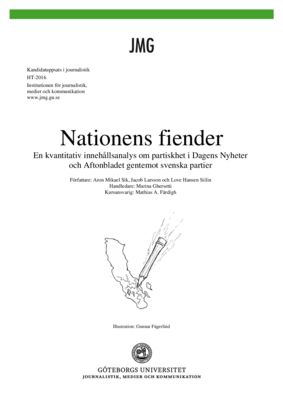
Nationens fiender
This study aims to show to what degree that two of largest newspapers in Sweden, Dagens Nyheter and Aftonbladet, might be biased towards any of the Swedish political parties. We also want to see if Dagens Nyheter and Aftonbladet differ in their coverage of Swedish politics. These two newspapers are chosen due to their history as a morning paper (Dagens Nyheter) and a tabloid (Aftonbladet). They also come from different political traditions and still to this day Dagens Nyheter call themselves independent liberal in editorials. Liberal in a Swedish context means center/right on the political left/right spectrum, while Aftonbladet calling themselves independent social democrats.
We want to see if there are any differences with regard to what kind of news/issues they report on, to what degree they report, and how they treat the political parties in parliament. The purpose of this study is to add further research to the election studies done by Kent Asp since 1979 and Bengt Johansson who overtook the task in last election (2014). In doing so we adopted their method and therefore have done a quantitative content analysis.
We have read the paper edition of both Dagens Nyheter and Aftonbladet every fourth day starting on July 1st all through November 9th of 2016. By doing so we have covered a larger period of time and thereby eliminating part of the risk of getting stuck in a particular scandal or other kind of affair, which would be misleading data wise. We have analyzed over 300 articles and more than 500 actors on the Swedish political scene.
What we found is that Dagens Nyheter are staying true to their role as a “morning paper” in that they are more focused on “harder” news and also have more political articles during the period we studied. By the same token, Aftonbladet are still functioning as a tabloid newspaper and have a political commentary that is more openly taking sides. Aftonbladet also have a larger degree of superficial, sensationalistic news articles than Dagens Nyheter.
Studying how the political parties are portrayed in the two largest daily newspapers in Sweden, we have found that virtually all parties are getting a fairly neutral coverage. A few exceptions aside, there are more neutral than positive or negative articles written about the parties. One of these exceptions is Feministiskt initiativ, which doesn’t have any representation in parliament. Out of the three articles about them, one of them was positive and two were neutral.
Moreover, there is also a strong tradition of scrutinizing public officials in Sweden, which we think is transparent in the material that we have worked with in this little study of ours.
Att lägga örat mot gatan
This is a comparative case study that looks at public journalism as an ideal in a Swedish context, and how this ideal affects the journalist role. Public journalism is defined as an ideal where the agenda of the public is dominant and where the ordinary citizen is allowed more space in the news compared to traditional journalism. This should not be confused with citizen journalism where the public produces content independently and outside of the
established newsrooms. Public journalism was developed in the U.S. in the 1980s and the idea was to make the citizens engage in society – first and foremost by voting as the interest in politics was generally low at the time. In other areas public journalism was used to increase the social status of socioeconomically deprived areas. In Sweden several newsrooms have tried out public journalism as a method, but not always on a conscious level. However, there’s one exception, and that’s the free local newspaper Södra Sidan in Stockholm. They started as a reaction to the fact that other media didn’t cover what happened in the suburbs of Stockholm in a nuanced way. Very little research has been done on the topic of public journalism in Sweden, therefore our aim was to look at the role of the journalist within this context. Specifically we have studied how the journalists view public journalism in relation to their professional ideals, what challenges they experience and how they relate to the citizens.
This study examines two different publications: Södra Sidan and GöteborgDirekt. Both are owned by the same newspaper group, DirektPress. But while the journalists at Södra Sidan has public journalism as a consciously underlying ideal in their work, the journalists at GöteborgDirekt hasn’t. We were keen to examine if, and how, this ideal affected the
journalist role. In depth-interviews were made with journalists at Södra Sidan and GöteborgDirekt. To analyse our material we used the theory of professional discourse combined with democratic models based on the philosophy of Habermas.
Our result shows that due to a lack of resources on both papers, it was hard to fully live up to the intention of meeting the citizens outside of the office. But it was clear that the journalist role at Södra Sidan was in many ways different from the traditional journalist role.
We found that a dominant ideal for the journalists at Södra Sidan was to turn away from the traditional news reporting about crimes and politics, and instead let the citizens set the agenda for what topics to discuss. This could cause ethical dilemmas as it implies that they also need to consider people with anti-democratic values, such as citizens who neglect human rights of
refugees. At GöteborgDirekt the approach was more straightforward news reporting even though they also used some methods associated with public journalism in their work. But as the journalists at GöteborgDirekt did not view public journalism as a main ideal, the journalists remained more traditional in their journalist roles.
Nyckelord: public journalism, medborgarnära journalistik, lokala nyheter, medieskugga, deltagande, deliberativ demokrati, samtal, dialog, professionsteori, Södra Sidan, GöteborgDirekt, Habermas
”Så här har vi gått tillväga”
Title: “Så här har vi gått tillväga” – En kvalitativ studie av hur svenska undersökande journalister förhåller sig till transparens
Authors: Michael Larsson and Rasmus Lygner
Subject: Undergraduate research paper in journalism studies,
Department of journalism, media and communication (JMG), University of Gothenburg
Term: Fall 2016
Supervisor: Nicklas Håkansson, JMG, University of Gothenburg
Pages/words: 54 pages/19 485 words (including abstract and appendix)
Purpose: The main purpose of the study is to examine how Swedish investigative journalists relate to the notion of transparency and apply it in their everyday work routine.
Method: Qualitative in-depth interviews with Swedish investigative journalists.
Procedure: Seven interviews with investigative journalists were transcribed and analyzed using Erving Goffman’s dramaturgical perspective, Michael Karlsson’s rituals of transparency and professional theory.
Results: The results of the study show that although transparency have not been accepted as a new occupational norm by all investigative journalists, it affects their relationship with the audience and way of working.
Transparency was associated with a wide variety of practices employed by investigative journalists – such as making source material public, getting the public involved in the news process or using transparency as a form of storytelling – and regarded as a way to enhance credibility with audiences. Furthermore, in some cases transparency was described as increasing self-regulation among investigative journalists and being in conflict with the confidentiality of sources.
Key words: Journalism, transparency, investigative journalism, trustworthiness, Erving Goffman, Michael Karlsson, impression management, professional theory, self-regulation, digitalization, professionalism, in-depth interviews, credibility, journalistic rituals
Andra sidan är ni klara?
Authors: Victor Bomgren, Karl Jansson & David Jespersson
Title: Andra sidan är ni klara? Level: Bachelor of Journalism Location: University of Gothenburg Language: Swedish
Number of pages: 46
A lot has been said about football fans. And a lot has been said about what is being said about fotball fans.
Football fans are violent, criminals, troublemakers, dedicated supporters, colourful, musical and missunderstood. Since the very beginning of the sport they have played their part: Singing their hearts out, waving their flags, fighting rival fans and thrown coins on the players on the pitch. They are indeed an interesting bunch of people and newspapers love to write about them, a lot.
The purpose of our study is to map how evening newspapers in Sweden have been writing about football fans. To correctly account for every article that has been written about swedish football fans is a tall order for sure, and would take a considerable time to complete. We haven’t been that ambitious, but still have managed to gather a significant amount of articles that give us a right to argue that we can, with some accuracy, make assumptions about how the swedish evening newspapers Aftonbladet and Expressen have been writing about football fans since the mid seventies.
We conducted a quantitative content analysis of articles written about Stockholm derbies including the clubs Hammarby, Djurgården and AIK between the years 1975 to 2015. We read all the articles related to the derby from the day of the game and the day after. The reasoning behind this was that these two days are the article heaviest with the articles from the matchday building up to the game and the articles from the day after dissects the events on the pitch as well as on the stands.
We marked all articles related to the derby into SPSS but stopped coding after six variables if the article didn’t include any mention of fans. If the article did, however, we marked up to twenty variables. The variables ranged from placement of the article in the newspaper, nature and size of the article, in what context fans were mentioned, in what manner the fans were described, who are featured in the article with quotes and opinions, if the fans were described as a collective or as individuals to how supporters were portrayed in pictures.
The choice of newspapers to study was a fairly easy one as Aftonbladet and Expressen are evening newspapers with the country’s largest coverage of sport news.
Tolkandets tid
This study examines the development of political news analysis during three routine periods, 2004, 2008 and 2012, using framing and mediatization as a theoretical framework. In order to examine this development, we have analyzed political news journalism in Aftonbladet, Expressen, Dagens nyheter and Svenska dagbladet – the four largest, nationwide papers. We aim to utilize previous research whenever possible and these four papers stood out from a cumulative research perspective. We chose this theme for the study partly because of the lack of research on political news journalism during between election periods. We saw this as an opportunity to provide new insight to the field of mediatization research. We wanted to see if there would be any correlation between our results and those of the election focused studies.
Our results show that while political news analysis has decreased slightly from 9 percent of political news journalism in 2004 to 8 percent 2012, overall, interpretative news journalism has increased. From 26 percent 2004 to 41 percent 2012. We can also see that framing politics as a game, rather than reporting the actual political issues, has increased from 41 percent to 48 percent 2012. In addition to this we looked at the number of direct sources in political news journalism. In our research we have found that there are no directly cited political sources in 69 percent of the political news journalism.
We cannot see a substantial change in the amount of political news analysis during our research period. But we have seen a growing tendency to frame politics as game, which can be attributed to the increasing mediatization of the political sphere. This has happened in concordance with the increase of interpretive approach to political news journalism. The amount of directly cited political sources is least prevalent in articles that frame politics as a game. This type of journalism is also vastly increasing in number, largely a result of mediatization.
All this leads us to believe that there has been a migration of interpretation from analysis to traditionally descriptive news articles
Sverige i Sputnik News
Uppsats/Examensarbete: 15 hp
Program och/eller kurs: MK1500 Medie- och kommunikationsvetenskap
Nivå: Grundnivå
Termin/år: Vt/2016
Handledare: Britt Börjesson
Kursansvarig: Malin Sveningson
Sidantal: 57
Antal ord: 19511
Nyckelord: innehållsanalys, kvantitativ, nyhetsbyrå, Ryssland, propaganda
Syfte: Syftet har varit att undersöka vilka huvudsakliga ämnen och aktörer som behandlas i nyheter från Sputnik News samt den bild nyhetsbyrån förmedlat av den europeiska migrationskrisen 2015-2016 med avseende på Sverige
Teori: Deskriptiv statistik och tidsserieanalys. Med utgångspunkt från prospektteorin och teorier kring social identitet studeras migrationsfrågan i artiklar publicerade av Sputnik.
Metod: Kvantitativ innehållsanalys
Material: Webbpublicerade artiklar i den engelskspråkiga editionen av Sputnik News under perioden 1 april 2015 – 31 mars 2016.
Resultat: De artiklar Sputnik News publicerat under den studerade tidsperioden och som berör Sverige har varit koncentrerade till ett fåtal ämnen. De handlar framför allt om internationella relationer, migrationskrisen, militär verksamhet och kriminalitet. Olika aspekter av säkerhetspolitik är ett återkommande tema. Bland personaktörerna i det studerade materialet har statschefer, politiker, diplomater och myndighetsföreträdare framträdande roller. Den mest förekommande personen i artiklarna är dock Julian Assange. Mansdominansen är i det närmaste kompakt. Sputnik refererar i sina artiklar till ett brett spektrum av andra nyhetsmedier. Från svensk sida är DN, Sveriges Radio och SVT de mest citerade källorna. Kontroversiella mediekällor förekommer, men inte i någon större omfattning.
En genomgång av Sputniks artiklar om migrationsfrågan visar att det huvudsakligen är ämnen med negativa förväntade följder som dominerar, påfallande ofta för såväl Sverige och hemmahörande i Sverige som för migranter i analysdimensionen social identitet.
Slutligen har Sputnik av allt att döma inte någon större publik, när man fogar byråns egna siffror till analysen. Nästan 40 procent av artiklarna har haft färre än 500 besökare. De mest lästa artiklarna under tidsperioden har samtliga handlat om migration.