On subsequent days, the 18th and 19th of December 2012, large groups of young people gathered to protest in the centre of Gothenburg. The gatherings mainly occurred outside two high schools: Plusgymnasiet and Framtidsgymnasiet. The reason behind the gathering has often been explained by the young people’s reaction to an Instagram account, on which offensive pictures and comments of and about young boys and girls had been published. As a reaction to the protest, police force including helicopters and mounted police, was sent to the streets. Disorder occurred. The high schools were closed. About 20 protesters were temporarily taken in to custody. Ever since, the events has, in Swedish mass-media, often been referred to as the “Instagram-riots” or the “Instagram-uprising”. Our study aims, with help from Ethnographic Content Analysis (ECA) and a quantitative content analysis, to show how this protest was framed in four Swedish newspapers: Aftonbladet, Göteborgs-Posten, Göteborg-Tidningen and Metro Göteborg. The study is based on the theoretical perspective of framing, it’s components, and on earlier research of protests. The mass-media today possess a powerful position. By framing they may affect how the public will understand and evaluate a protest-movement. Our major findings show that violent elements of a “riot”, episodic interpretations of cause and solution, a coverage mainly based on police sources, and a negative tone is prominent in framing the events.
Författararkiv: linneus
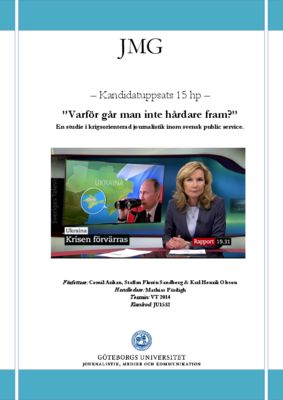
”Varför går man inte hårdare fram?”
Title: ”Varför går man inte hårdare fram? – En studie i krigsorienterad journalistik av Public Service från Ukrainakonflikten” Authors: Cemil Arikan, Staffan Florén Sandberg and Karl Henrik Olsson Subject: Undergraduate research paper in journalism studies, Dept. of journalism, media and communication (JMG) Gothenburg University Term: Spring 2014 Supervisor: Mathias Färdigh, JMG, Gothenburg University Pages/words: 48 pages/16701 words Purpose: The main purpose of the paper was to examine if and to what extent the conflict coverage of two Swedish public service news programmes from the ongoing Ukrainian conflict could be said to orientate towards either war or peace journalism. Method: Quantitative and qualitative content analysis Procedure: News broadcasts from Rapport 19:30 and Dagens Eko kvart-i-fem, covering the Ukrainian conflict, over a period of two months, were analyzed from the normative perspective of Johan Galtung’s peace journalism theory and Wilhelm Kempf’s theory of war and peace discourse. Results: Both Rapport and Dagens Eko were found orientating towards war journalism. Reports were given, in a great extent, to events of violence and verbal threats. The conflict was largely conceptualized and constructed as a competitive struggle between Russia on the one side and Ukraine with its western allies on the other.
Två sidor av myntet
Title: Two sides of the same coin. A quantative content analysis of how Swedish daily press frames begging Authors: Mirjam Hultin, Linda Moström & Caroline Widenheim Subject: Undergraduate research paper in journalism studies Location: Dept. of journalism, media and communication (JMG) University of Gothenburg Term: Spring 2014 Supervisor: Britt Börjesson, JMG, University of Gothenburg Language: Swedish Number of pages: 45 (excluding appendix) Background: During the late twentieth century, there was a debate in the daily press concerning the increase of homeless and beggars in Stockholm. Voices arose wanting to make it illegal to beg, especially in the subways. Today, the issue is again up for debate now focusing on the increase of migrants from poor countries of the European Union. Purpose: The main purpose is to examine how the phenomena beggary is portrayed in the daily press. We aimed to make a comparison between two periods, 1997-2000 and 2007-2013, and between different newspapers. Method: A quantitative content analysis of four major Swedish newspapers using a digital archive and a search string designed to sort out all articles concerning beggars in Sweden. A total of 352 articles from four major newspapers from the first and the second period were coded and analysed. Results: In our compared periods of time, we met two different portrayals of people begging and beggary. The person who is begging is in most cases being talked about and may rarely be heard, while as politicians and/or office holders are most frequent as main agents. In the nineties, the person begging is (implicitly) swedish, while during the 21st century, half of the articles presents the “beggar” to be from Romania. The most common is to not state a cause to the beggary, but when they did in the nineties the most common was homelessness, addiction and poverty. In the 21st century, the most common cause is poverty, though it is interesting that coercion and discrimination never was mentioned in the nineties, while today it’s mentioned frequently.
Sporterna som syns
In this study, our purpose has been to investigate whether Swedish local newspapers allow some sports more space than others in the sports pages. We also wanted to see whether the distribution of different sports in newspapers sports pages have changed over time. We also wanted to investigate the extent to which men and woman appear in the local newspapers sports pages. For this end, we have used a quantitative content analysis. We proceeded by coding 1 408 articles from three different local newspapers sports pages. To see whether the distribution of various sports in the sports pages changed over time, we have also compared our results to another study, which conducted a study on the same magazines nine years earlier. Our results were analyzed from a hegemony perspective, agenda-setting and a news value theory. Our results show that soccer and ice hockey are clearly the most exposed sports in the sports pages. In a comparison with the previous study, it also appears that soccer and ice hockey increased its exposure in the newspapers over time. The most common topic that is written about in the sports pages is league matches followed by international competitions. The result also shows that a majority of articles takes place locally, followed by nationally and finally internationally. A man is clearly the most prominent main character in the articles as well as the pictures. There is also a clear majority of men who writes the articles.
Märken i morgonljuset
Authors: Agnes Källén & Amanda Redin Title: Level: Bachelor of Journalism Location: University of Gothenburg Language: Swedish Number of Pages: 39 With this study we aimed to answer the following questions: has the amount of brand exposure on the Tv4 show “Nyhetsmorgon” increased between the years 2008 and 2013? And if so, how can the increase be explained by well-recognized research in the field? The media industry is changing toward an increasingly commercial content. In television, this change is mainly caused by the growth in shows watched on the web and through time shift, which is the act of watching something on a digital video recorder, or DVR. This gives the viewer the possibility to fast forward through the commercial breaks, and therefore forces the networks as well as the advertizer to find new ways to reach consumers. Hence the plausible growth in product placement and brand exposure. A Swedish new radio and tv law that came into effect in 2010, regulated the previously unregulated area of product placement, which adds an interesting paradox to our above stated questions. Our findings were that the brand exposure indeed had increased, but only slightly. The difference in registered brand exposures was shown to only be about 6.5 procent. However, other findings were that the number of brand exposures increased on Wednesdays, Thursdays and Fridays, as to prepare the viewers for potential purchases during the weekend. Other patterns within the brand exposures were found as well, for example that most exposures were found to be considered as “neutral”, portraying the brand neither positively nor negatively. All findings were then connected to and explained by established research theories.
På bänken
The world today is not an equal place. We see children starve, people being discriminated and women’s rights being neglected. The media coverage of women’s sports is no exception. In this study we have explored the difference between men’s and women’s media coverage in Swedish sports journalism. This has been done by using quantitative method together with interviews in order to define why the coverage is the way it is. Our theoretical points of departure are gender theories, identification theory and the news value theories gatekeeping and agenda setting. A central part of our study has been to analyze which factors determine how much space women’s sports get in Swedish media today and if it’s possible to change these. Our main research questions have been: – How is the space divided between men’s sports and women’s sports in SVT, TV4, Sportbladet and Sportexpressen? – Why is the space divided the way it is? We found that Swedish media covers women’s sports much less than men’s sports. In general, men’s sports take 80 percent of the media coverage and women’s sports take the remaining 20.The reasons for this could be the lack of female sport journalists, the economic interests of media and/or the overall public interest in women’s sports. These factors depend on each other. Therefor we have come to the conclusion that we need more women in the sports journalism field in Sweden, both as reporters and on the executive posts to make sports and sports media coverage more equal.
“Du är partiledare (…) men inte minst en helt vanlig människa”
Title: “Du är partiledare (…) men inte minst en helt vanlig människa” – En studie av partiledarnas framträdanden i Nyfiken på partiledaren. Authors: Marcus Alakangas and Martin Ridderstolpe Subject: Undergraduate research paper in journalism studies, Dept. of journalism, media and communication (JMG) Gothenburg University Term: Spring 2014 Supervisor: Mats Ekström, JMG, Gothenburg University Purpose: Our main purpose is to examine whether there is a pattern of similarities to which the Swedish party leaders adapt to in their narratives and presentation of self in the television show Nyfiken på partiledaren. Method: Etnographic Content Analysis Procedure: The first part of all eight episodes was transcribed and analyzed from the perspective that the interviewee is doing a presentation of self. Results: There are tendencies that the party leaders adapt to similar patterns in their narratives and presentation of self. The main aspect of that is in the way they portrait themselves as ordinary persons that people can relate to. Another aspect is that the narratives they put forth are in coherence with their political views. The private and political personas of the party leaders intertwine.
Powerplay
The purpose with our study was to see if and how the amount of articles regarding different sports has changed during the last three decades. If it had changed our target was to se how and why it had changed. We have performed a quantitative content analysis. In the analysis we have studied the two national Swedish newspapers Dagens Nyheter and Aftonbladet. In doing so we have created two synthetic weeks in each of the years 1986, 1999 and 2012. In total we coded almost 2000 articles. In our analysis we used the theories about the commercialization of journalism. Our thesis where that an eventual change could have to do with the commercialization of sports journalism, something that has escalated during the last decades. What we found in our study was that two sports dominate Swedish press, football and ice hockey. That was the case in all of the three years in our study. The difference though is that the two sports share was considerably larger in the latter years of our study, with an exception of football in Aftonbladet where we could see a slight decline from 1999 to 2012. That was anyway compensated by the fact that the number of large articles was greater in 2012. Our conclusions was that we could see a change in the share of different sports in the Swedish press but that the change mainly is that the large sports have received even more attention in the press. We cannot be completely sure that the change is an effect of the commercialization of journalism. What we can say though, is that it probably is an effect of the commercialization with support of statistics regarding television ratings and live attendance.
Det bortglömda valet?
Title: Det bortglömda valet? – En kvantitativ undersökning av mediernas bevakning kring Europaparlamentsvalet 2009 Authors: Elin Kullander and Sara Lundin Subject: The media coverage of the election of the European parliament 2009 Term: Spring 2014 Supervisor: Mats Ekström, JMG, Gothenburg University Pages/words: 44/11 065 Purpose: The purpose has been to investigate how great the media coverage was on the European parliament elections in 2009 and then compare the result to previous elections. The discussion is based on media’s role as a multiplier in a democracy. Method: We have used a quantitative method and studied the media coverage in four Swedish newspapers 23 days before the Swedish election on 7th of June 2009. Results: We have come to the conclusion that media is in fact meeting its democratic role as a multiplier, in any case as long as we only take in conclusion the amount of articles that has been published. We have seen that the media coverage for the first time has increased both in number of articles and in how big the articles were. However, we have to take into account that this does not have to mean a “greater” amount of democracy since we have not done a more qualitative analysis of the information. On subjects it seems that the articles more and more concern the low voter turnout and less about different subjects which the parliament is actually deciding about.
Storstadsmorgontidningars förhållande till annonsörer
This bachelor thesis focuses on metropolitan morning newspapers in Sweden and their relationship with advertisers. Various forces in society have led to changes in partnerships between metropolitan newspapers and advertisers, which have previously only had small amounts of data. In these particular newspapers, it is common to find editorial advertisement supplements. The reason these supplements are included, their benefits and how they can affect the paper’s credibility have not previously been investigated. I have researched how the changed collaborations between the metropolitan morning newspapers and advertisers look today; including the contact, power and dependence they have on one another. I have also examined the newspaper’s advertising departments affect the credibility of the journalistic product linked to the editorial advertisement supplements. I have furthermore examined the trends and tendencies of advertisement in metropolitan newspapers. The purpose of this study is to describe the phenomena I have investigated and based on my findings give an overall perspective of how it looks in general at metropolitan morning newspapers; there similarities, differences and what these depend upon. For the purpose of being objective and not allowing personal opinions ruin the reliability of my research, I have chosen to interview two persons at each of the newspapers that I selected. This is justified by the fact that decisions concerning partnerships with advertisers and evaluations of advertisements potential impact on the credibility are rarely taken by a single employee. The results from my research regarding metropolitan morning newspaper’s relationship with advertisers can, in some cases, be linked to changes that have occurred in society. In other situations, decisions were made internally at the papers regarding their relationships and amount of cooperation. The results, although partly predicted, have shown surprises that were not anticipated. Overall, it provides a picture of how the relationships and the cooperation between the newspapers and advertisers exist today, and to some extent, how it might look in the future.