This study is a media analysis of the representation of adolescents in Swedish news media, undertaken during the spring 2017.
Theories about diversity and representation state that the media should reflect different groups of the society. As one of these groups young people have a right to be represented in the media. However, the idea is complex since they are at the same time considered a group that needs protection from harmful portraying.
The aim of this study is to examine the coverage of adolescents in the news content of the five largest newspapers in Sweden: Dagens Nyheter, Aftonbladet, Svenska Dagbladet, Expressen and Göteborgs-Posten. The study aims to find out how often underage teenagers (13-17 years) occur, in what context and how the image of adolescents is constructed in the material. This study was carried out using a quantitative content analysis and consisted of 1789 articles. These were published in the newspapers news content during 14 randomized days during the period January 31-April 2. To guide the study and analyze its results theories mainly about diversity, representation and news value have been used.
The results show that underage teenagers occur in 62 articles or 3.5 % of the material, while the group constitutes about 5.5 % of Sweden’s population. When they do occur they are rarely quoted or pictured. Out of the 62 articles where an adolescent occur they speak in 15 and appear in photos in 12 – making them fairly quiet and invisible. Of the entire material where we can expect at least one person being quoted underage teenagers are being quoted in 1.5 %. Looking at the context where adolescents are being portrayed, 64.5 % or 40 of 62 articles are news about crime and violence. Comparing to the entire material where crime and violence constitutes 25.5 % of the articles one can conclude that the group is overrepresented in the crime category. Most of the adolescents portrayed are either perpetrators or victims of crimes. The majority is men. The results show that the diversity of the group is lacking; the individuals are rarely attributed another sex than male or female, and there is little or no diversity when it comes to sexuality, religion or disability. The idea of diversity however is in direct conflict with the idea of the ethics of the press. Those guidelines suggest that these attributes should not be emphasized at all if it has no significance to the news story.
Key words: adolescence, teenagers, representation, diversity
Nyckelord: ungdom, tonåringar, representation, mångfald
Författararkiv: Anna Fredriksson
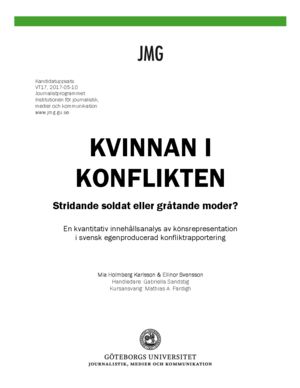
KVINNAN I KONFLIKTEN Stridande soldat eller gråtande moder?
The purpose of this study is to acquire knowledge of how much and in what way women, compared to men, are portrayed in Swedish self-produced conflict reporting. The aim is to investigate the quantitative representation of the sexes and to conclude to what extent men and women get to play
leading, subordinated or minor parts, and to what extent they get portrayed with stereotypical masculine and feminine attributes. This has been achieved by performing a quantitative content analysis on 334 articles and segments from Swedish press, radio and TV during the years 2011 to 2016. The dates were chosen by a simple random sample in order to form six weeks, seven days each per year since the Arab spring broke out in 2011. This specific period of time allowed us to get results that are representative of the global situation of today.
The study has been performed with a gender perspective. The questions asked to our empirical material, and the operationalization of the masculine and feminine attributes, have been formed on the basis of theories established mainly by gender researchers Cynthia Enloe, Monica Löfgren
Nilsson and Liesbet van Zoonen. This theoretical framework has allowed us to understand and analyze whether and to which extent the active, passive, hard and soft attributes are given to men or women in Swedish conflict reporting.
The findings of the study show that women in general are represented to a much less extent than men in Swedish conflict reporting. Men represent the absolute majority in all contexts investigated.
Only two out of ten people in the study’s empirical material were women. Looking exclusively at visual content, women are represented slightly more but the gender balance remains approximately the same. The study also concluded that women are scarce in expert roles and leading parts.
The results of the study confirm earlier research on conflict reporting both in Sweden and other countries, by showing that women are in the minority, are portrayed as victims and often only are present as a male appendage. Men appear more often in the empirical material with military focus,
and women more often with civilian focus. These analyzed results follow the established patterns of the study’s theoretical framework. Men are in the absolute majority regarding active roles and hard attributes, and women are, compared to men, more frequently portrayed in passive roles with
soft attributes.
Key words
Conflict reporting, women in conflict reporting, news subjects, gender, gender roles, masculine
and feminine attributes, gender representation, quantitative content analysis
Nyckelord
Konfliktrapportering, kvinnor i konfliktrapportering, nyhetssubjekt, genus, könsroller, maskulina
och feminina attribut, könsrepresentation, kvantitativ innehållsanalys
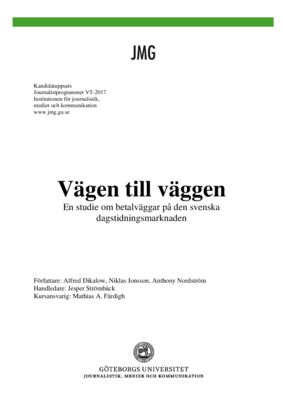
Vägen till väggen
During the last decades, the Swedish newspaper industry has seen a decline in circulation and ad revenues. Most of the Swedish daily newspapers are present online, and has been since the middle of the 1990s. The general situation has been that the news offered online are free to read, and as a result, daily newspapers have relied on ad revenues to fund their presence online. With the rise of major players on the online ad market, such as Google and Facebook, the newspapers in Sweden have been faced with a new problem when it comes to making their online presence profitable. A solution to the problem, brought forth by the daily newspapers, has been to implement paywalls on their online news sites.
This study examines the general situation for Swedish daily newspapers when it comes to paywalls. By using a quantitative method, the study examines the occurrence of paywalls on Swedish daily newspapers, as well as examining what kind of paywalls the Swedish daily newspapers use. Furthermore, the study tries to seek out the incentives that the Swedish daily newspapers have when it comes to implementing a paywall, as well as examining the reasons for choosing a specific type of paywall. This is done by using a qualitative method in the form of semi structured interviews with representatives from five Swedish media groups.
Our study shows that around two thirds of the Swedish daily newspapers already have some kind of paywall implemented on their online news sites, and that the most common type of paywall is the soft paywall. The results from our study also show that the type of paywall that an online newspaper uses, seem to be dependent on what news group the newspaper is a part of, and if one publication in a newsgroup uses a certain type of paywall, the rest of the publications in the news group are likely to use the same type. Furthermore, the study shows that several of the daily newspapers without some form of paywall, are going to be implementing one in the near future.
The main reason for implementing a paywall seems to be a general opinion amongst the media groups, which argues that the newspapers need more than just one source of revenue in order for them to be financially viable.
Keywords: Paywall, Swedish newspapers, Digital revenue, Digital subscriptions, Online news, Paid content
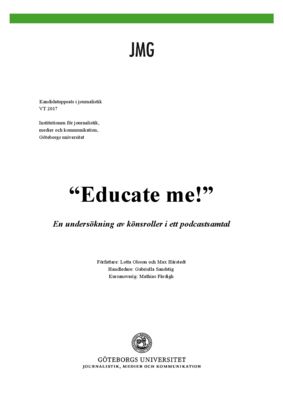
“Educate me!”
The aim of this study is to make an initial attempt at investigating how conversations between men and women are structured in Swedish podcasts. More specifically, it uses Conversation Analysis to investigate how gender roles are recreated in podcasts as a new media format.
This is done by looking at how the word is distributed in terms of speaking time, share of lines and share of interruptions. It is also done by looking at how men and women approach different conversation topics.
The material used in this case study is a transcript of one episode of well-known Swedish food podcast Eat This! which is hosted by one female and one male. By analysing the transcript both quantitatively and qualitatively, we found that the conversation structure in our case study simultaneously recreated and strayed away from the gender roles found in our selection of literature. In terms of how the two hosts divided the conversational space, there were infinitesimal differences between the female and male host. This deviates from how a mixed-sex conversation is usually organized, in the way that the man commonly takes up
more time and space. However, in regards to how the different hosts approached different conversation topics, gender roles were re-established. The woman took on a more personal, intimate viewpoint when discussing a subject while the man had a more distanced and status-inclined way of addressing different topics. In conclusion, the study shows that while
gender roles are reaffirmed in the podcast format, the medium can serve as a space where new types of conversations and voices are allowed to take place.
Key words: Conversation Analysis, Podcast, Gender, Gender Roles, Conversational
structure, Lifestyle Journalism, Media, Medium.
1
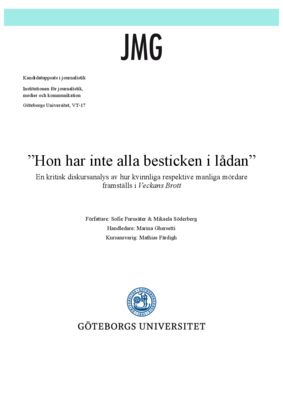
”Hon har inte alla besticken i lådan”
Title: ”Hon har inte alla besticken i lådan” – En kritisk diskursanalys av hur kvinnliga respektive manliga mördare framställs i Veckans Brott
Author: Sofie Furusäter & Mikaela Söderberg
Subject: Undergraduate research paper in Journalism studies, Dept. Of Journalism, media and communication (JMG) Gothenburg University
Term: Spring 2017
Supervisor: Marina Ghersetti, JMG Gothenburg
Pages/words: 38/15648, excluding appendix and reference-list
Purpose: The purpose of this paper is to examine how the Swedish television program Veckans Brott portraits female and male murderers.
Method: Critical Discourse Analysis
Procedure: 10 cases (within 14 episodes) were analyzed through Critical discourse analysis.
Results: Our analysis show some differences between the portrayal of the male and female offenders in the Swedish television program Veckans Brott.
Key words: Crime, gender, media, murderer, Veckans Brott, narratology, discourse
analysis, norm
Nyckelord: Brottslighet, genus, medier, mördare, Veckans Brott, narratologi,
diskursanalys, norm
Har du hört om Angered?
A little more than one year ago, the local broadcast media SVT Nyheter Väst established a local editorial office in the suburb Angered outside central Gothenburg. The reason, according to SVT Nyheter Väst, was a will to improve their reporting about these suburb-areas included in their broadcast-area. They wanted to report about Angered and its surrounding areas in a more multifaceted way. Our aim with this study was to investigate how the news from SVT Nyheter Väst about Angered changed over time. We wanted to compare the news, concerning its character and amount, before and after the opening of the local office.
One important aspect concerning which happenings that become news and which happenings that do not, is the geographical distance to the happening. The less geographical distance, the more likely that the happening becomes a news story. In this study, we wanted to see if the presence of SVT Nyheter Väst in Angered affected the news from Angered and its surrounding areas in terms of their character and amount. Hence, we studied the broadcasts news from SVT Nyheter Väst from a period of time before the establishment of the local office in Angered and from the same period one year later, after the establishment of the office. We analyzed 30 of SVT Nyheter Västs broadcasts by using the method of quantitative content analysis. The broadcasts were randomly picked from a period of two months. They included 15 broadcasts from December 2015 to January 2016 and 15 broadcasts from the same period one year later, December 2016 to January 2017. The theories that we have used when analyzing our results are the theory of news values, the framing theory, framing and the theory of orientalism.
The results seem to show that the news from SVT Nyheter Väst about Angered and its surrounding areas are few. Five percent of all of the news that we analyzed were from and about Angered and surrounding areas. When we compared the period before the establishment of the local office with the period after the establishment, the results indicated that the amount of news from Angered and surrounding areas were less after than before the establishment. 70 percent of all news from Angered and surrounding areas that we analyzed were broadcasted from the period before the establishment and the rest 30 percent were broadcasted after. The results indicated that the head topics of these news never were about crime or accidents, which is the most common subjects in the overall news according to Hvitfelt (1985) and Ghersetti (2012). Instead, the head topics seemed to be about integration, care, school and culture. The results also indicated a difference in the character of the news from Angered and surrounding areas comparing the periods before and after the establishment of the local office. After SVT Nyheter Väst established the local office in Angered, the news about the area seemed to be portrayed in a less negative way. Further, we noticed that after the establishment of the local office, the news from Angered and its surrounding areas appeared to be described from a within-perspective more often than were the news from the period before.
The presence of an editorial office in Angered, and the reduced geographical distance between the editorial office and the area that the journalists at the office are intended to cover, seem not to increase the amount of the news from Angered and its surroundings.
Instead, our results indicate that the presence of an editorial office in a specific area seems to influence the news from that area in terms of their character.
The news from Angered and its surrounding areas that we analyzed also seemed to differ in many ways from the rest of the news from SVT Nyheter Väst, as well in terms of the head topics of the news and amount as in what way they were portrayed. This tendency appeared to pertain for both periods, as well before the establishment of the local office in Angered as after.
Keywords: editorial presence, geographical distance, local journalism, suburb, suburban (news)reporting.
Nyckelord: redaktionell närvaro/närhet, geografiskt avstånd/närhet, lokaljournalistik, förort, förortsrapportering.
Imiterad demokrati
In January of 2017 Martin Kragh and Sebastian Åsberg published a research article titled “Russia’s strategy for influence through public diplomacy and active measures: the Swedish case”. One of the main theses of the research article was that the cultural pages of Swedish tabloid Aftonbladet repeatedly uses narratives from Russian government operated news agency Sputnik, often accused of being a Russian propaganda outlet. Aftonbladet Kultur resented the accusation and a Swedish researcher pointed out methodological flaws in the article, flaws
Martin Kragh later warded off.
One of the dominant themes Kragh and Åsberg found in the articles in Sputnik was that of a “positive image of Russia”. We argue that if Aftonbladet Kultur were to use narratives from Sputnik and thereby spread Russian propaganda, one would be able to detect a positive image of Russia in their reporting. The purpose of this study is to determine whether Martin Kragh and Sebastian Åsbergs accusations against Aftonbladet Kultur are legitimate.
In this bachelor thesis we examine whether Aftonbladet Kultur are spreading a positive image of Russia. The method used is qualitative comparative text analysis and the theories taken into consideration are framing theory, attribution theory and Karen Phalet and Edwin Poppe´s theory of evaluation of national stereotypes through competence and morality. By looking at the
overall image of Russia presented in Aftonbladet Kultur and also comparing it to the cultural pages of the other major Swedish tabloid, Expressen, we seek to determine whether the image presented in Aftonbladet Kultur is unreasonably positive.
The main findings in this study are that the image of Russia presented in the cultural pages of both tabloids is negative. There are small differences between the two cultural pages, one of them being the way they explain negative Russian actions. Aftonbladet Kultur are more likely to explain negative behaviour with external factors like outside pressure, while Expressen Kultur explain nearly every negative action with internal factors like the temper or underlying motives of the Russians. Also Aftonbladet Kultur are less likely to paint the picture of Russia as a threat than Expressen Kultur are. In both cultural pages Russia’s morality is described as low whereas their competence in Expressen Kultur most often is described as high and in Aftonbladet Kultur described as somewhat lower. With the differences being small we find that Aftonbladet Kultur are not spreading a positive image of Russia in the articles studied.
Keywords: Russia, Putin, Framing, Attribution, Aftonbladet Kultur, Expressen Kultur
URBANISERINGENS OFFER BERÄTTAR
Uppsats/Examensarbete: 15 hp
Program och/eller kurs: Medie- och kommunikationsvetenskap
Nivå: Grundnivå
Termin/år: Vt2017
Handledare: Magnus Fredriksson
Kursansvarig: Malin Sveningsson
Sidantal: 43
Antal ord: 15 605
Nyckelord: Strategiskt berättande, strategisk kommunikation, deltagarorienterad kommunikation, landsbygdskommuner, kommuner, rationalitetsprinciper, aktantroller, agentroller, hyckleri
Syfte: Studiens syfte är att undersöka hur kommuner konstruerar berättelser för att framställa en positiv bild av kommunen, när dess faktiska verklighet framstår som negativ.
Teori: Blandning av aktantroller (Greimas, 1966), agentroller (Propps, 1968) för att undersöka berättelsestrukturen, och Boltanski och Thévenots (2006) rationalitets-principer för att blottlägga vilka värden som realiseras.
Metod: Kvalitativ innehållsanalys
Material: Kommunala styrdokument innehållandes framtidsvision, nulägesanalys, strategier och målsättningar. Styrdokumenten kallas ofta översikts- och)verksamhetsplaner.)
Resultat: Resultat och analys visar att kommunerna hanterade de motstridiga kraven främst med hjälp av hyckleri, det vill säga att de åtminstone strävar mot det som anses önskvärt i samhället, men också genom att skylla ifrån sig på externa och okontrollerbara faktorer. Studien visar också att deltagarorienterad kommun-ikation har betydelse för den berättelsestruktur och bild som målas upp på ett sätt som konstruerar en mer positiv bild av kommunen, eftersom det gör att invånare involveras i strävan mot målet samt kan bidra till att andra värden blir får betydelse. Vidare genomsyras kommunikationen av kreativitetens principer och värden men de är alltid underordnade och legitimeras av värden produktionens, ryktbarhetens eller marknadens principer. Med det menas att den kreativiteten inte har ett värde i sig, utan det används som ett medel för att skapa nya idéer om lösningar på kommunens problem, generera företagsamhet, innovation och konkurrenskraft, bidra till varumärke och image samt uppnå organisationens mål.
KOMMUNIKATION, MEDIER OCH ÖVERVIKTIGA BARN
Uppsats/Examensarbete: Kandidatuppsats, 15 hp
Program och/eller kurs: Examensarbete i medie- och kommunikationsvetenskap
Nivå: Grundnivå
Termin/år: Ht 2016
Handledare: Marie Grusell
Kursansvarig: Malin Svenningsson
Sidantal: 59 exkl. försättsblad och bilagor
Antal ord: 18904
Nyckelord:
Hälsokommunikation, Barnfetma, Digitalisering, Medievanor,
Informationssamhälle, Folkhälsa, Västra Götalandsregionen,
Syfte: Syftet med undersökningen är att studera hur föräldrar och barn inom Västra Götalandsregionen uppfattar och förhåller sig till kommunikation kring övervikt/fetma hos barn, och att placera målgruppens medieanvändning och digitala livsstil i en (o)hälsokontext.
Teori: Studiens teoretiska referensram grundar sig i mottagarstudier, encoding/decoding, attitydteori och uses and gratifications.
Metod: Uppsatsen har en kvalitativ ansats och har genomförts genom samtals-, telefon- och mailintervjuer med de deltagande svarspersonerna. Inför intervjuerna genomfördes en pilotstudie. Materialet har transkriberats och analyserats utifrån ett analysschema för att identifiera centrala teman.
Material: Urvalet är koncentrerat till föräldrar till barn med erfarenhet av övervikt/fetma, tillhörandes Västra Götalandsregionen. Deltagarna är sex till antalet och representerar fyra av fem hälso- och sjukvårdsnämnder i landstinget. Svarspersonerna har en mängd olika yrken och gruppen består av fyra kvinnor respektive två män. Deltagarna är anonyma med fiktiva namn i uppsatsen, och barnen omnämns enbart med bokstaven X.
Resultat: Studiens resultat visade att medier till stor del är delaktiga i att forma målgruppens uppfattning, attityder, kunskapsnivå och informationshämtning vad gäller övervikt och fetma hos barn. Det framkommer även att det finns brister i kommunikationen från och
med Västra Götalandsregionen. Digitaliseringen syns tydligt i deltagarnas svar, där detframkommer att såväl barn som vuxna är vana användare av olika digitala tekniker, som de också önskade blev en större del av landstingets kommunikation och behandling.
“INGEN BIKINI BLIR SNYGG PÅ EN GRÖNVIT KROPP”
Uppsats/Examensarbete:
15 HP
Program och/eller kurs:
Examensarbete i Medie- och kommunikationsvetenskap – PR, opinionsbildning och omvärld
Nivå:
Grundnivå
Termin/år:
Ht 2016
Handledare:
Johanna Arnesson
Kursansvarig:
Malin Sveningsson
Sidantal:
52
Antal ord:
18595
Nyckelord:
Popular culture, lifestyle magazines, beauty ideals, tanning, framing
Syfte: Att undersöka hur innehållet i populärkulturella livsstilsmagasin uppmärksammar solning samt att vara solbrun.
Metod: Kvalitativa innehållsanalyser
Material: Fyra svenska populärkulturella livsstilsmagasin – Amelia, SOLO, Veckorevyn och Frida under perioden september 2015 till augusti 2016
Huvudresultat: Studien kom fram till att det främst var i två sammanhang som magasinen pratade om solning och att vara solbrun, nämligen hälsa och utseende, där utseende var det dominerande. Kunskapen om att solens strålar är farliga är utbrett men specifikt hudcancer togs sällan upp. Snarare skulle riskerna med solens strålar has i åtanke när man solar och men inte nödvändigtvis behöva stoppa en. Det talas lika mycket om solens negativa effekter på utseendet som på hälsan då den sliter på hud och hår och kan orsaka förtidigt åldrande. Det blir uppenbart att magasinen främjar ett solbrunt skönhetsideal där en blek hy är ett problem som bör lösas. Magasinen ger förslag på hur läsarna strategiskt kan uppnå idealet antingen med hjälp av brunprodukter så som smink eller brun-utan-sol eller genom att sola. Sammanfattningsvis är en solbränna något som enligt magasinen ska framhävas, förstärkas och förlängas.